Sidra Azhar Dar, a courageous journalist
 Chehra WebDesk
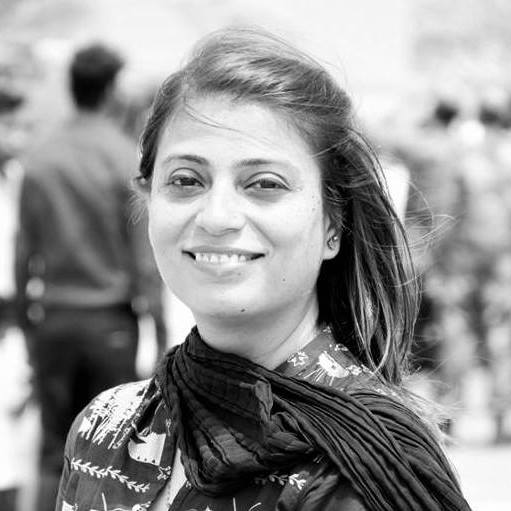
Sidra Azhar Dar, a woman journalist who is always treated with kindness from the little ones, has earned a name not only in journalism but also in writing, perhaps a journalist of Karachi has achieved so far. happened The secret of their successful life is known from their words

I did BA Honors in Political Science and I am a Gold Medalist from Jinnah University for Women and my Masters is also in Political Science of one year so understand that I studied Political Science for four years and in Master. It was also my position.

In the family I belonged to, there was no special tendency for girls to get more education, so I was the first girl in my family to reach the university, so this was also a great achievement, and it was my intention from the beginning to become a journalist. I will go, but there were many problems in going to the university, so the department I got in which I arrived at the right time was political science, but during that time, I was doing all these things, writing dramas and writing articles for the university.
So I had a good tradition of writing since my university days. At that time I used to write for various newspapers, which was my first company, a food magazine. I got a job as an editorial assistant in 2010 and I worked there for two years. I used to do things. Then after 2012 I went to Geo News in 2013 as a researcher.

In the election cell and then in 2013, I entered reporting, that is, I entered TV reporting in geo News, then I stayed in geo till 2015, and in 2016, I joined Neo TV and in 2018, I joined Voice Of America till now I am working with same as far as coming in journalism since 2010 I have been working in this field for almost 13 years.

My main focus in reporting has been humanitarian reporting. I work on human rights and I work on women's issues. I have also worked on environment, climate change, minority community, conflict areas. During the time she was in geo news she was doing crime reporting and covering the terrorist incidents that happened at that time.
After doing M.A as I said, I was in a print magazine, after that I joined Geo news regularly. So I was not given any training etc. Yes, it is definitely this institution that taught me how to write. How is the TV news made? How are the OCVOs?

It's part of the training in the sense that you're sitting in the newsroom working and learning before things start to make sense. But Desk was very helpful in explaining and learning these things. Apart from this there is a regular training on what you should do and what you should not do. There was no such training as how to work and not to work.

According to me, professional training is very important and it is necessary for everyone, whether he has done masters in politics or economics, if he is working in the field of Journalism , training is necessary because the kind of Journalism we have in Pakistan is a journalist. He doesn't know what to do. It should be said that the force of the wind is working on the direction of the wind. So everyone should know the do's and don'ts. I have also seen many journalists who have done masters in journalism but they are also making serious mistakes
So, training is needed till the last age, as long as it is in the professional life. Now the question is that generally those who did not do MA Journalism or those who had less academic education turned out to be better journalists. He proved to be a better journalist because he had a passion for learning and earlier those who were social sciences people were in newspaper and TV journalism .

Now a course called media studies is being taught in private universities, they are learning multimedia reporting. Today's children are quite sound. They are also much better in terms of technology. But what used to be done was training inside the newsroom. The elders are teaching you. They are scolding you.

Then they were told how to write for TV, so all these things were journalists, that's why they were good, they did research and there was a standard of things. But I will say this again The need for training is therefore greater. Every journalist should know what are the principles of journalism. DO AUR DON'TS when you work in the field DO AUR DON'TS Do's and Don'ts are a must with any academic study.

I was never briefed by my agency before going to the crime scene. And they didn't tell me anything. This was the first incident in my life. I was being sent to a place. The reporter who was sent with me had different issues of the crime scene and he left me alone and ran away. And I was the same. Direct came from. INFACT This is the most memorable event of my life and also the most dangerous event
.The place where they left me. The gang members who were there helped me to get out of the area because they saw that I should not become a bait. I did not mention the explosion to anyone for a long time. He explained to me that he should have told the institution. A senior reporter had left his home to save his life.
At that time, I was being shown that this is how reporting is done. All these things were not known. Since then, I started searching on my own. How to do all this? I am talking about 2013 when the situation in Karachi was very bad. What did you do?
No instructions were given or any such thing was said while sending to the bomb blast site. Nothing like that was said. She used to tell the TV that the best footages should come and close shots should come. No such thing was said to the reporter. Everyone used to think that we are the first to break the news, and many journalists lost their lives.
It happened before our arrival, it also happened later
A tradition was going on A tradition was going on First there was an explosion few minutes later there was another explosion.
The most difficult thing is that men don't think of you as a journalist, they see you as a woman. They laugh at you, they say that it will be five o'clock, then you will go home. There are many constraints. You will do it. It is your level. You will be afraid of blood. You will be afraid of bomb explosion. .
You're afraid of cockroaches. It's different kinds of taunts and taunts that you're reading in the newsroom. With big love and sugar-coated attitudes. But the same thing. It is a tradition that we also saw it, I also heard it. I remember well when I was attacked for the first time at the Razzakabad Police Training Center, I was sent to Jinnah Hospital. My cameraman left me in the mortuary van. Saw a mortuary van for the first time in my life
In which six or seven dead bodies were coming out, he left me and stood with the other cameraman.
It is very difficult because people have eyes on you. Why is she standing here? Well, how will she do it? She will be scared. Information is readily available
It does not happen when the men who work with you judge you, whether it is the head of an institution, whether it is the police department, whether it is the courts, whether it is anyone else, they judge you as a woman. They don't give favors, favors can give something else, they offer you, but they don't give your information so quickly.
She is talking to the police department, so it can be a perspective of the people. Yes, a woman has gone, she will get the news quickly. This is not the case. Women have to prove first that yes, I am a Journalist. I have the same importance as a man. And don't look at it in terms of gender difference, the profession doesn't look at gender.
I am in a foreign channel, I still charge for these things.
When a woman comes to Journalism, she comes by deciding that she has to work in this profession.
If there is something in front of you, the profession which is given to you, you cannot do it. If you come into this field with passion, then only he who will go to all extremes and undergo trials can advance with passion.
For me, reporting was a passion. I have done all kinds of reporting. Everywhere I went, I still go. I still try to do hard reporting. I've seen people die in Vive, I've seen bodies torn apart in bomb blasts, I've seen bodies come out of mortuary vans. I have visited inside the mortuary, dead bodies of terrorists used to come, I have seen them. Nobody has a leg, nobody has a hand in the bomb blast and that person is sitting. I have seen people bleeding, I have seen people crying and sobbing in every way, I have seen all the things
. You have the courage to see all these things when you are very intact. Yes, I have to do this work, so there is no justification for you to say, yes, how can I do this as a woman. There are no gender roles in journalism. In this you can report in all kinds of difficult situations and in emergency situations, it is not difficult for a guy for whom journalism is everything.
It is very important that you are aware of the risks. Things are learned over time based on experiences. First of all, journalists need to understand that when going to a crime scene, do not cross the lines of where the crime took place, do not try to erase the evidence where there is a tape, do not cross the line here. The same tape is being crossed and trying to break in. You stay at a distance
While covering a terrorist incident, you should also look at the culture of the area where the terrorism happened, the norms there, the demography, you should have research work in advance. Do not give your thoughts, ideas, or point of view there. You see what happened. Report it. * Do not be a party. Do not take sides. And he is believing that I have done it, that I have done it
Include mandatory interviews of officials if they are not available at this location then you should talk to them on phone. Ask them and in your reporting say that we have spoken to that, they have confirmed everything. Do this with attributes so that you are doing very factual reporting in the conflict area where you are working. If there are monitors monitoring you, you are doing very factual reporting.
If you are dealing with facts and no one is talking here and there, then these are the things and take care of yourself, you should not stay there for a long time, if there is danger, then report in a safe place. You also have to take care of your security. Keep your organization informed after a while. I am moving from here. I am leaving here. . This may also threaten my life. I will leave here and go to a safe place and give you information. It is very important for you to do all these things.
I have submitted to you that there are many journalists who have degrees but they do not know how to do it. Today is the age of social media. If you don't do anything, I think it's enough for a good journalist, a journalist should know this. I have to cover things. I'm not presenting an analysis. You're not a decision maker. The job is to give facts and figures and report on the place where he stands.
Safety journalism is not only your physical and mental training, it also tells you how to make decisions, what your role should be in the place you are standing, what you should do and what not to do. If you are in a risk, how will you cover it?
Many people don't know that there is an outside book on Safety journalism . I have translated it into Urdu from America and it is very detailed. By the way, you can easily get this information on the internet. You have to go to a place which is a conflict area or a war zone or a terrorist incident or a clash or an issue or any incident has happened.
Don't hurt your body, don't hurt your mind. It also depends on what you have to talk about and what not to talk about. .

I have received a lot of training and as time went by I realized what I needed to learn. I wanted to work on human Rights. I wanted to work on them in natural disasters. I took humanitarian reporting. Take the training I did on climate change.
I trained in safety journalism. I took trainings on digital security. I received three trainings on how to write better from foreign channels people. Then there is still the training of Judicial Securities.
Since citizen journalism came about, everyone calls himself a journalist. Anchors in our country also call themselves journalists. While he is not Prometer Reader also calls himself a journalist while he is not. A producer also calls himself a journalist. NLE also calls himself a journalist.
I think the desk people also need to come forward and train. They are related to the reporter. So they also need stress management. They are putting their stress on others. So they also know how to make decisions. How should the reporter work. This is the need of everyone except the field desk people, the production people say that the owners also need turning.

Pakistan will never get out of censorship because every government that comes sets a separate category for itself and runs the journalism in the same way.
We have seen that journalism has made its own way. Just like you can't block a river, it makes its own way. But even with censorship, there are many people who are doing good work and I think they will continue to do it, you can't stop them.
Newspaper was left behind by TV, then TV was left behind by social media. After social media, something else will come. So today is the era of social media. I think people use Twitter instead of watching TV. Use social media. Because the news comes there first and the biggest thing is how many reporters are there on TV channels.
Pakistan has so many districts, there are so many cities in these districts, there cannot be a representative in every city. So, if there is any news, it reaches you. There are cases of torturing children in madrassas, there are cases of Zainab murder, it comes through social media, it is power, people get the news first. There is no clause in this. Social media has left the electronic media far behind.

This is the age of digital media. Everything has an advantage and a disadvantage. Since the advent of social media and digital media, misinformation and disinformation have increased so much that people do not consider the truth to be the truth, they consider the lie to be the truth. Then propaganda, all these things, they do not feel the difference between right and wrong. So this is also a disadvantage. But the same thing is bad, but nothing can be called bad, many things are going well.