Sindh’s Leading Training Institution
 Ishak Soomro
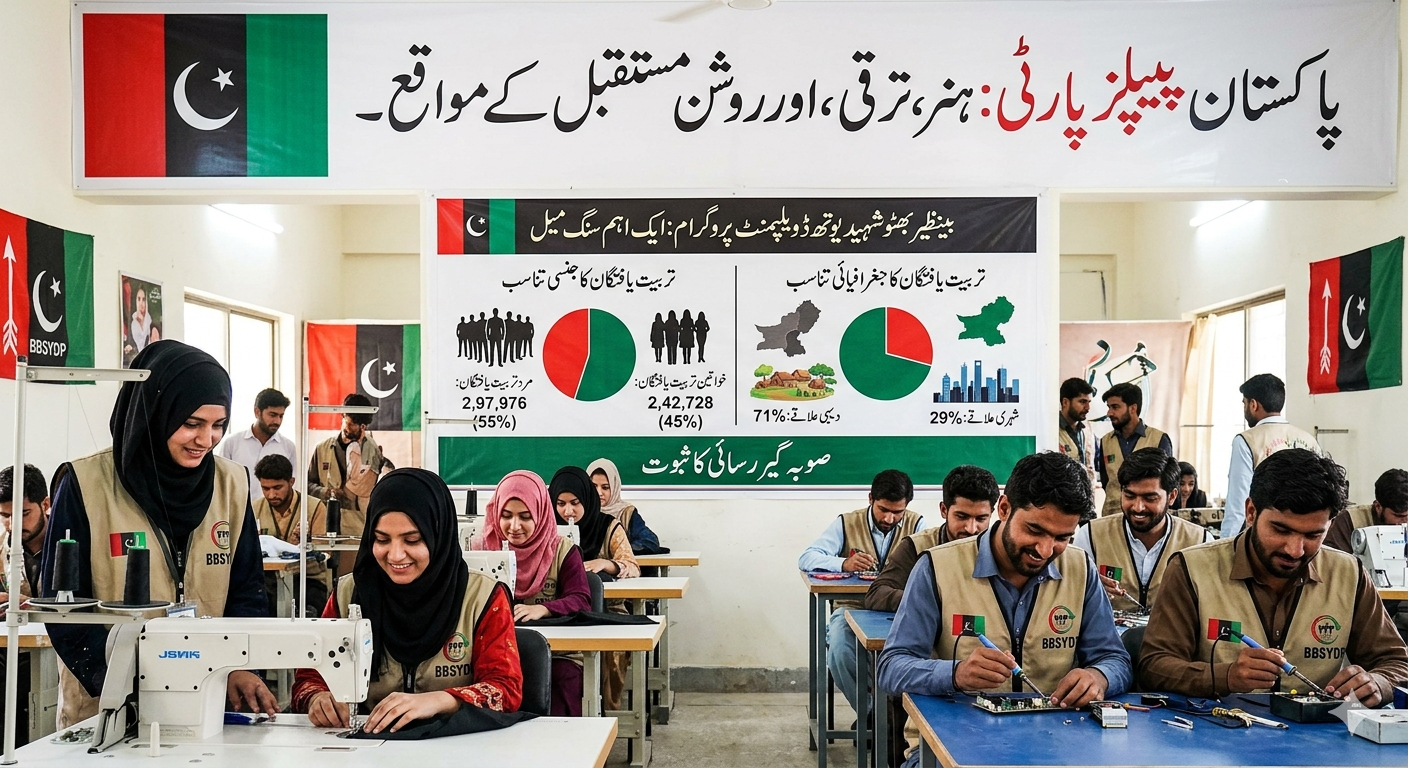
The Government of Sindh, under the first tenure of the Pakistan People’s Party after 2008, launched a visionary initiative aimed at addressing youth unemployment and poverty through skill development. This initiative, introduced in 2008-09 as the Benazir Bhutto Shaheed Youth Development Program, was designed to equip unemployed youth with technical and professional skills to improve their employability and economic independence.
Recognizing the growing need for an institutional framework to sustain and expand this initiative, the Sindh government later established the Benazir Bhutto Shaheed Human Resource Research and Development Board (BBSHRRDB) under the Sindh Assembly Act, 2013. Since then, the Board has emerged as one of the most important public-sector institutions in Sindh dedicated to technical education, vocational training, and human resource development.
This initiative is unique in Pakistan as a large-scale government-supported youth training project that provides free technical, vocational, and information technology (IT) training to unemployed youth across Sindh. Its primary objective is to enable young people to secure dignified employment, improve their livelihoods, and contribute positively to the provincial and national economy.
According to the Pakistan Labour Force Survey, nearly 1.5 million youth in Sindh remain unemployed. This alarming figure highlights the urgent need for skill development and employment generation programs. Through its consistent efforts, the Board has so far trained more than 540,000 youth in a wide range of technical and professional disciplines, making a significant contribution toward reducing unemployment.
Under the Board’s framework, multiple categories of training programs are being conducted, including short courses of 4 to 6 months, skill-based technical courses of 1 to 6 months, and long-term diploma and professional programs ranging from 1 to 4 years. These programs are offered through public colleges, universities, and reputed private-sector institutions across Sindh.
The training portfolio is highly diversified, covering fields such as information technology, health sciences, automobile engineering, industrial skills, aviation services, garment technology, hospitality, renewable energy, and other emerging sectors. Importantly, trainees are also provided with a monthly stipend, enabling students from low-income families to continue their education and skill development without financial hardship.
The Board has ensured equitable access to training opportunities for both men and women in all 30 districts of Sindh. Statistics from 2008 to 2026 indicate that 763,329 youth registered under the program, of whom 540,750 received training, while 422,701 successfully completed their courses. Most notably, approximately 172,000 trainees secured employment, reflecting a placement rate of nearly 41 percent among graduates.
The gender distribution of beneficiaries also reflects encouraging inclusivity. Out of total trainees, 297,976 were male (55 percent) and 242,728 were female (45 percent). Likewise, the program has achieved strong rural outreach, with 71 percent of trainees coming from rural Sindh and 29 percent from urban areas.
The scale of operations is impressive. The Board has conducted 28 training batches in 414 different trades, collaborating with 1,634 private-sector institutions and 14 public-sector institutions. In addition, through partnerships with international development agencies such as the World Bank and UNICEF, approximately 114,732 youth received additional training opportunities. More than 5,000 beneficiaries of the Benazir Income Support Programme (BISP) have also been trained under specialized schemes.
One of the most commendable aspects of this initiative is its inclusive approach. The Board provides dedicated training programs for prisoners, persons with disabilities, transgender persons, and other marginalized communities, ensuring that economic empowerment reaches disadvantaged segments of society.
To further strengthen post-training outcomes, the Board has introduced initiatives such as soft loans, grants for graduates, stronger industry linkages, career counseling, job placement support, and coordination with the Sindh Technical Education and Vocational Training Authority (STEVTA). A centralized digital database of trained graduates is also being developed to facilitate employment matching through the Board’s official platform.
The Board has also signed a Memorandum of Understanding (MoU) with the Department of Empowerment of Persons with Disabilities (DEPD), reflecting the Sindh government’s commitment to inclusive and equitable development.
Nevertheless, despite limited financial resources, the Benazir Bhutto Shaheed Human Resource Research and Development Board continues to play a transformative role in youth empowerment, skill enhancement, employment generation, and human capital development in Sindh.
If provided with adequate financial support, policy continuity, and stronger government patronage, this institution has the potential to become not only a model for Sindh but also a benchmark for youth development programs across Pakistan.
Professional Profile: Ishak Soomro
Ishak Soomro is a highly experienced professional specializing as a Journalist, Research Associate, and Columnist with a distinguished career spanning 15 years
He possesses extensive expertise in multilingual communication and analysis, having written and contributed across three major languages: Sindhi, Urdu, and English
ishaksoomro@yahoo.com