CM Murad Ali Shah reaffirms Sindh’s unity, rejects any proposal to divide province
 Imran
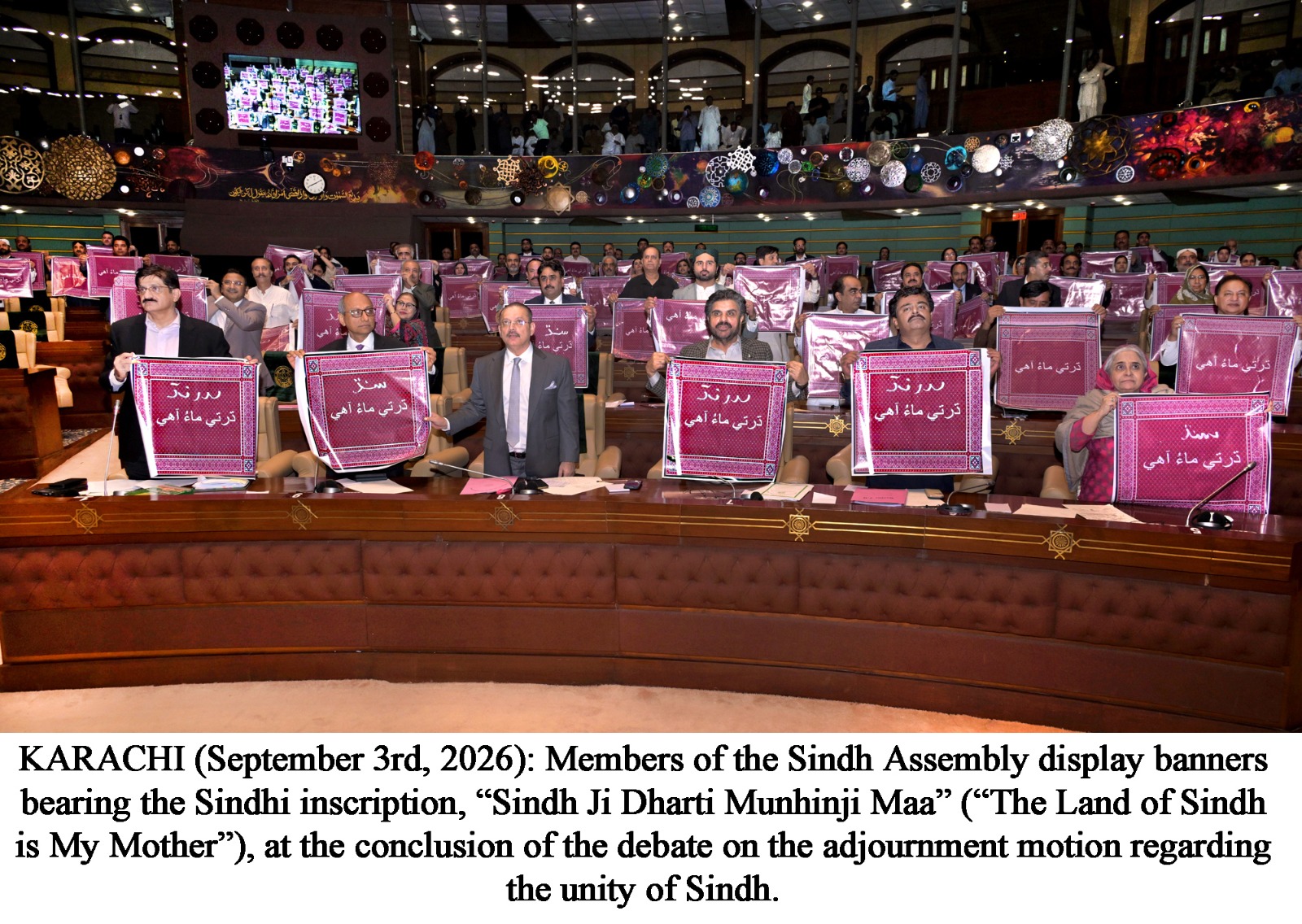
Says Sindh entered Pakistan as a united province and will remain united; Assembly adopts firm stance against any move to create parallel provincial structures within Sindh
KARACHI Sindh Chief Minister Syed Murad Ali Shah on Thursday delivered a forceful defence of Sindh’s geographical, constitutional and political unity in the Sindh Assembly, declaring that any proposal aimed at dividing the province or creating parallel provincial structures under the guise of administrative units would be unacceptable.
Concluding a debate on an adjournment motion regarding Sindh’s unity, he said Sindh had joined Pakistan as a single, united province and that its territorial integrity could not be altered against the will of its people or their elected representatives.
The Chief Minister said the debate was initiated by the Pakistan Peoples Party (PPP) parliamentary party in response to recent statements by certain political leaders advocating new provinces or separate administrative units. He stressed that such an important matter should be discussed in the constitutional forum of the Sindh Assembly rather than through political rhetoric outside the House.
Murad Shah criticised what he described as contradictory positions adopted by MQM leadership some political parties who publicly opposed the division of Sindh while simultaneously proposing separate assemblies, chief executives and governance structures for various divisions of the province.
“If separate assemblies, chief executives and administrative structures are being proposed, then calling them administrative units instead of provinces does not change the substance of the proposal,” he remarked, adding that while administrative reforms and improved governance were welcome, any arrangement that effectively created parallel provincial structures could not be accepted.
Sindh’s historic role in Pakistan’s creation
Highlighting Sindh’s historic contribution to the creation of Pakistan, the Chief Minister recalled that the Sindh chapter of the All-India Muslim League adopted a landmark resolution in 1938 under the leadership of Quaid-e-Azam Muhammad Ali Jinnah, which later laid the foundation for the Lahore Resolution of 1940.
He further noted that Sindh was the first province whose elected assembly voted in favour of joining Pakistan. Referring to the historic session of the Sindh Assembly held on June 26, 1947, he said 33 members voted in favour of joining Pakistan while 20 opposed the motion.
“Before Pakistan came into existence on August 14, 1947, Sindh had already decided to become part of the new country,” he said, recalling that the then Speaker of the Sindh Assembly had remarked that Sindh reached the gates of Pakistan before any other province.
Defence of Sindh’s constitutional rights
The Chief Minister said Sindh had consistently defended its identity and constitutional rights throughout history, whether in opposing the separation of Karachi from Sindh in 1948 or resisting the One Unit scheme.
He maintained that the One Unit arrangement was wrong when it was imposed and remained wrong today, arguing that the assembly which endorsed it did not truly represent the people of Sindh.
Paying tribute to Shaheed Zulfikar Ali Bhutto for giving Pakistan the 1973 Constitution, Murad Shah said subsequent military regimes altered its original spirit. He particularly referred to constitutional changes made during General Zia-ul-Haq’s era, including amendments affecting Article 239 and issues related to provincial boundaries.
Sindh Assembly’s consistent position
Murad Shah reminded the House that the Sindh Assembly had repeatedly passed resolutions against the division of Sindh whenever such proposals surfaced, including in 2012, 2014, 2019 and again in 2026.
“We have always made it clear that any attempt to divide Sindh is unacceptable. The elected representatives of Sindh will never allow decisions about the province’s future to be imposed from outside,” he said.
He revealed that after consultations among treasury members, senior PPP leader Nisar Ahmed Khuhro proposed that the debate culminate in a formal resolution reaffirming Sindh’s unity. The Chief Minister noted that the Khyber Pakhtunkhwa Assembly had recently passed a similar resolution against the creation of new provinces.
Population not a basis for new provinces
Rejecting the argument that population growth alone justified the creation of new provinces, the Chief Minister said administrative necessity - not population size - was the accepted basis for such decisions. “India has states with populations ranging from more than 240 million to as low as 650,000 people. Provinces are created according to administrative requirements, not merely population figures,” he said.
Drawing international comparisons, he pointed out that even in the United States, the creation of new states historically required the consent of the affected state. He cited California as an example, noting that despite substantial population growth, it had not been divided solely because of demographic expansion.
“Population increase by itself is not a sufficient argument for creating new provinces. Governance challenges should be addressed through administrative reforms and better service delivery,” he added.
Criticism of opposition parties
The Chief Minister praised legislators from both treasury and opposition benches who spoke in favour of Sindh’s unity during the debate, saying several opposition members had categorically rejected the division of the province.
At the same time, he criticised the absence of some opposition parties during the concluding stages of the debate. He claimed that certain PTI members had earlier expressed support for the motion but did not participate when the matter came before the House.
Murad Shah also accused the Muttahida Qaumi Movement-Pakistan (MQM-P) of taking contradictory positions on the issue. He said that while a consensus resolution on Sindh’s unity had been prepared, some opposition members sought to include provisions relating to new administrative units and devolution of powers.
According to the Chief Minister, the government proposed discussing those issues through a separate resolution because parliamentary rules required each resolution to focus on a single subject. “Instead of supporting the consensus resolution on Sindh’s unity, MQM chose to walk out of the House,” he said.
‘Interior Sindh’ terminology and provincial harmony
Objecting to the frequent use of the term “interior Sindh,” Murad Shah questioned whether Karachi should then be considered “outside Sindh,” arguing that such terminology reinforced unnecessary divisions within the province.
He also recalled the experience of migrant families who settled in Sindh after Partition and became an integral part of its social fabric. “My own elders migrated to Sindh and adopted this province as their home. Anyone who embraces Sindh can rise to the highest offices and earn the respect of its people,” he said.
The Chief Minister added that love for Sindh strengthened, rather than weakened, commitment to Pakistan. “If you love Sindh, your love for Pakistan only grows stronger,” he remarked.
Concluding the debate, Murad Shah reiterated that the division of Sindh was not a matter for negotiation and firmly rejected any proposal aimed at altering the province’s territorial integrity. He emphasised that Sindh became part of Pakistan as a united province and would remain united.
“The division of Sindh cannot be negotiated. Sindh entered Pakistan as a united province and will remain united. The dreams of dividing Sindh will never be realised,” he declared, adding that the Sindh Assembly would continue to oppose any move that sought to undermine the province’s unity and constitutional status.