MRD Movement 1983 Movement
 Ishak Soomro
Four decades ago, almost all political parties in the country formed the Movement for the Restoration of Democracy (MRD) to end General Zia-ul-Haq's dictatorship and martial law in the country. It was the largest joint alliance for the restoration of democracy in modern Pakistan.
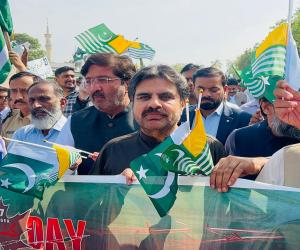
The movement was officially launched on 14 August 1983 across the country. In the first phase, the central leaders and workers of political parties took part in major cities including Karachi, Lahore, Quetta, and Peshawar, among others. The movement started very quickly in Sindh, with a large number of people participating. Thousands of people used to gather during the arrests of leaders in Sindh.
When the activists appeared to make arrests, crowds of people would throw garlands at them, shout slogans and march towards the police stations. They were arrested and taken away by police and other agency officials on the way. The majority of those arrested were leaders and activists of the Pakistan People’s Party (PPP). while in Sindh, leftist parties, the Sindhi Awami Tehreek (Rasool Bakhsh Paleejo), and the Jamiat Ulema-e-Islam were also.
Within a few days of the movement, thousands of workers were arrested from Sindh. Sindh's jails and police stations were full. It became difficult for the police and administration to keep them in jails at night. Those arrested in police stations were sent home at night, and they returned to the police stations in the morning. Clashes with the police, roadblocks, lathi charge, tear gas and vandalism were the order of the day.
The police station staff also hesitated to make arrests. During the movement, many police constables refused to perform their duties and started throwing their caps and belts, which created a situation like civil disobedience, especially in Sindh. The only source of news was newspapers, and there was censorship on the media. People used to gather in cities and villages every day to listen to the news from BBC London.
Many cities remained closed daily. Where there was a curfew-like situation. In addition to political activists, journalists, writers, poets and religious scholars were also arrested in this movement. Many of them were sentenced by military courts.
My journalistic journey also began in 1983 with reporting on the MRD movement. In such a situation, the then Sindh People's Party President Ghulam Mustafa Jatoi, who was leading the MRD movement, wrote a letter from Gharo Rest House (Thatta) and sent a message to the party workers to stop the movement, but the people of Sindh rejected his call and the movement continued in Sindh for several months. In the initial days, half a dozen workers were shot dead by law enforcement officials in the towns of Moro and Khairpur Nathan Shah.
The daily processions in Dadu, and especially the women's protests, also gave the movement national and international recognition.
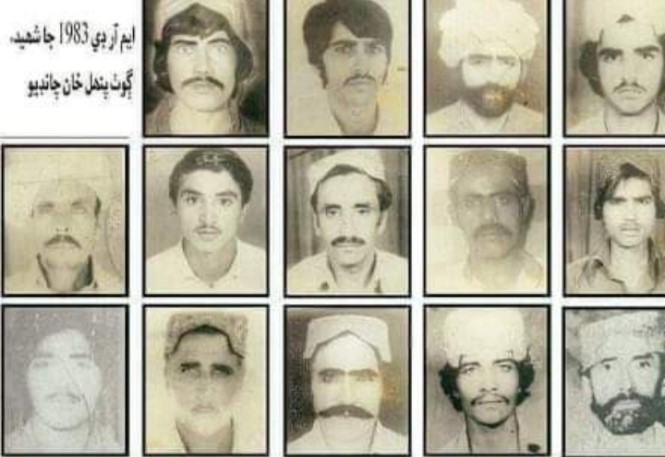
The biggest incident of the MRD movement occurred 42 years ago on September 29, 1983, on the national highway near the town of Sakrand. Where party workers and hundreds of villagers were protesting, law enforcement officials opened fire on them, resulting in 16 people being martyred and 51 injured and arrested.
The 70-year-old Punhal Khan Chandio and his son Ghulam Abbas Chandio, who led the procession, were arrested. They were tried in a military court in Khairpur and given severe sentences. The seriously injured workers were kept in the Civil Hospital in Nawabshah for several months and later taken away and imprisoned.
Among the martyrs were nine farmers, two students of Sakrand High School and a drum player who used to spread happiness by beating drums in the streets. One was a laborer in Sakrand town, one ran a shop, one was a milkman and one was a goat herder.
All of them belonged to the lower class. Most of the martyrs were young people. Those who were also injured that day were taken in military trucks along with other injured and dead bodies, first to the military camp in Nawabshah and then to the civil hospital in Nawabshah.
When I and some of my journalist friends from Sakrand town reached the scene, the blood of the martyrs and injured was still strewn on the national highway. Their shoes, slippers and other belongings were scattered. Eyewitnesses said that the protesters were empty-handed, those reciting the Holy Quran were fired upon indiscriminately and the brutal action continued for 4 hours. Many of the wounded were killed by the military trucks and many others died in agony.
The BBC reported the incident as the first news item on its newscast on September 29, 1983, and Radio Pakistan also broadcast the same news, stating that 16 people were killed and 50 injured in an exchange of fire between law enforcement officials and miscreants on the national highway near Sakrand town.
The next morning, hundreds of people from Sakrand city reached the village of Punhal Khan Chandi where the heirs of the martyrs were burying their loved ones. Apart from the heirs, MPA Ghulam Qadir Chandio was also present, who was receiving condolences from the people. His father Punhal Khan Chandio and brother Ghulam Abbas Chandio, along with his other male family members, were arrested. Ghulam Qadir Chandio is a representative of the working class who has been elected for 30 consecutive years. In 1995, Benazir Bhutto elected him as a member of the Senate of Pakistan for a six-year term. After that, he was elected as a member of Sindh Assembly for the fifth time. Ghulam Qadir Chandio has won every election since the 2002 election with more votes.
Today, more than 42 years have passed since this movement. This movement was more active in Sindh than in the rest of the country. In which the participation of the Pakistan People’s Party and left-wing parties was prominent. It should be noted that the nationalists of Sindh opposed this movement. Nationalist leader G.M Syed called this movement a movement of shroud thieves.
This historic struggle of the people of Sindh recognized the people of Sindh all over the world as supporters of democracy and opponents of dictatorship. The MRD movement remains an example of enthusiasm for democrats in the region even today.