CM Murad rules out division of Sindh without constitutional mandate, showcases Thar Mining Success at National Mining Conference
 Imran
Imran

Says Sindh Assembly has repeatedly opposed creation of new provinces; urges adoption of ‘Thar model’ of mining and community development across Pakistan as Mining Technical Conference 2026 brings together industry, academia and global technology leaders
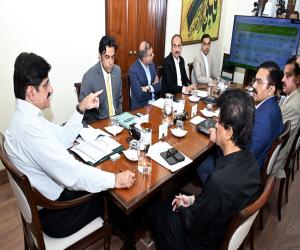
KARACHI Sindh Chief Minister Syed Murad Ali Shah on Wednesday categorically stated that the division of Sindh was not possible without following the constitutional procedure and reiterated that the Sindh Assembly had repeatedly passed unanimous resolutions opposing the creation of any new province from the existing territorial boundaries of Sindh.
Talking to the media after attending the Mining Technical Conference 2026 organised by Sindh Engro Mining Company (SEMC) at a local hotel, the chief minister said the Constitution of Pakistan clearly lays down the mechanism for creating new provinces, requiring the concerned provincial assembly to approve such a move through a two-thirds majority resolution.
“The Sindh Assembly has passed resolutions several times against the division of Sindh. Unless there is a constitutional change in that position, Sindh cannot be divided into more provinces,” he said while responding to a question regarding recent statements by Federal Interior Minister Mohsin Naqvi.
The chief minister said discussions on constitutional matters were not dangerous in themselves, but expressed confidence that the people of Sindh trusted the Pakistan Peoples Party government to safeguard the province’s interests. “The people of Sindh know that the PPP has both the commitment and the capacity to protect Sindh,” he added.
Earlier, addressing the country’s first-ever Mining Technical Conference, the chief minister highlighted the remarkable transformation of Thar from a drought-prone and underdeveloped region into Pakistan’s largest energy and mining hub, describing it as a model of successful collaboration among government institutions, private investors and local communities.
He said the conference had brought together mining companies, technical experts, equipment manufacturers, academics, development partners and policymakers to discuss the future of Pakistan’s mining sector and explore avenues for technological innovation, capacity building and sustainable development.
“We have achieved large-scale mining success in Thar, and the experiences gained there are being shared with stakeholders from across the country,” he said. “The Thar model of mining, rehabilitation of affected communities and support for local populations should be replicated elsewhere in Pakistan to unlock the country’s vast mineral potential.”
Murad Shah said Pakistan possessed enormous mineral resources, but unlocking their potential required sustained investment, modern technology and a predictable policy environment. He noted that Sindh had pioneered Pakistan’s modern mining sector through a public-private partnership framework introduced in 2008, laying the foundation for the progress witnessed today.
The chief minister stressed that the future of mining depended not only on capital investment but also on human resource development. He urged mining companies and industry stakeholders to invest in universities, technical institutions and training programmes to develop a new generation of geologists, engineers, environmental specialists and skilled technicians.
“The mining industry of tomorrow will be built by the talent we nurture today,” he remarked, calling for stronger partnerships between industry, academia and technology providers.
Highlighting the role of the Sindh government, Murad Shah said the province had acted as regulator, facilitator and development partner in major mining projects. He noted that the government had provided the legal framework, mining leases, infrastructure and institutional support necessary for the development of Thar’s coal resources.
He said two major mining projects in Thar - Block-I developed by Sino Sindh Resources Limited (SSRL) and Block-II developed by Sindh Engro Coal Mining Company (SECMC) - were currently producing more than 15 million tonnes of coal annually and generating around 2,640 megawatts of electricity for the national grid.
According to the chief minister, these projects were saving Pakistan more than $1.5 billion annually in foreign exchange by reducing dependence on imported fuels. He added that power generation capacity from Thar was expected to approach 3,000 megawatts in the near future.
Referring to Thar’s estimated 175 billion tonnes of lignite reserves, one of the largest coal deposits in the world, he said only a small fraction of the resource had so far been developed, leaving significant opportunities for future investment and expansion.
Tracing the history of the project, Murad Shah recalled that although Thar’s coal reserves were discovered in the late 1980s and confirmed in the early 1990s, progress remained slow for nearly two decades due to the absence of a regulatory framework, financial incentives and investor confidence.
He said the establishment of the Thar Coal and Energy Board in 2008, combined with major infrastructure investments by the Sindh government, had changed the trajectory of the project. The provincial government invested approximately US$750 million in roads, bridges, buildings, an airport and other critical infrastructure to support mining operations and improve living conditions in the region.
The chief minister emphasised that Thar’s development had always been envisioned not merely as an energy project but as a human development initiative inspired by the vision of Shaheed Mohtarma Benazir Bhutto.
“Our belief has always been that natural resources create real value only when local communities experience tangible improvements in their quality of life,” he said.
He highlighted several social development achievements made through the Thar Foundation and public-private partnerships, including the establishment of more than 75 schools serving over 5,000 students, free healthcare services for nearly half a million patients, 33 reverse-osmosis plants supplying around 12 million litres of clean drinking water every month, and the plantation of more than one million trees.
“These achievements demonstrate that human development is not a by-product of resource development - it is its most important outcome,” he observed.
The chief minister said the Thar experience had demonstrated that responsible resource development, environmental stewardship and community welfare could go hand in hand. He urged stakeholders to apply similar principles to the development of Pakistan’s vast reserves of coal, copper, gold, rare earth minerals and other strategic resources.
Murad Shah also welcomed discussions on establishing a Mining Industry Platform to serve as a permanent forum linking universities, research institutions, technology providers and mining companies. He said such a platform could accelerate innovation, technology transfer and skills development across the sector.
Turning to political matters during his media interaction, the chief minister criticised recent protests that disrupted traffic in Karachi, saying that while every citizen had the democratic right to protest, such demonstrations should not inconvenience the public or paralyse the city’s road network.
“Protest organisers must seek permission from the administration so that proper arrangements can be made to avoid inconvenience for the public,” he said, adding that the administration had taken necessary measures whenever attempts were made to block roads and disrupt traffic flow.
Responding to questions regarding wheat procurement and food security, Murad Shah said the Sindh government had allocated funds under its state trading mechanism to procure one million tonnes of wheat. Under the system, wheat procurement is financed through bank borrowing, with loans repaid after the commodity is sold and part of the financing cost subsidised by the government.
He said funds had also been made available for the procurement of 500,000 tonnes of imported wheat if required. However, he stressed that the government remained committed to protecting local growers and would avoid unnecessary imports that could negatively affect domestic producers.
The chief minister disclosed that the government had recovered approximately 300,000 tonnes of wheat through an extensive crackdown on hoarding and profiteering, helping stabilise flour prices in the province.
On the success of public-private partnerships in the mining sector, Murad Shah said the collaboration between the Sindh government, Engro, Chinese investors and other stakeholders had delivered tangible results.
“If anyone has any doubts, they should visit Thar and witness a successful partnership model for themselves,” he said.
Concluding his address, the chief minister reaffirmed the Sindh government’s commitment to facilitating investment, encouraging innovation, strengthening regulation, expanding infrastructure and supporting initiatives that unlock Pakistan’s mineral wealth while ensuring inclusive and sustainable development.
“The success of this conference will not be measured by today’s discussions alone, but by the partnerships, innovations and institutions that emerge from it. Together, we can transform Pakistan’s mineral resources into long-term prosperity for our people,” he said.