Rilli (Quilt), Ancient Handicraft of Sindh
 Asif Raza Morio

Handicrafts sort of arty and creative works have been manifestation of ancient and modern ceremonial practices of any region and the populations engaged in such handiworks can be counted as communal and enlightened possessor of such hierarchies. Such artisans have been appreciated by rank and file among sophisticated societies. Splendid region of Sindh has nourished thousands such stunning skills and crafts in her humble loam. Among such handy arts which have been historically & traditionally rooted into fertilized society of Sindh is Rilli (the quilt) a coverlet made of cloth.
Rilli is a cloth sheet made up with different colorful pieces of fabrics and can be used as bedspread. Its snobbery is that Rilli can be used to reduce the temperature in hot season whereas during summer it works to warm the wrapper. Rillies made in Sindh are thickly double layered than modern fancy bed sheets while are thinner than quilt. Amazing fact about Rilly is that since its evolutionary dawn these have been formed into human hands.
Birth place of Rilli
A question has constantly been asked from historians, artisans and Rilli makers that what is the native region of Rilli? For a while this query formulate the man all at sea since thumbs are down regarding that among historical scripts, books or commandments therefore proper answer has not been given in this connection but in my view point this subject is not much knotty as has been well thought-out by all. Nevertheless we don’t have any information about the indigenous place of Rilli but we do know about parental constituency of it.
It’s established truth by history that among three majestic civilizations of the world viz: Sumerian civilization of Mesopotamia, Egyptian civilization of Nile valley and Indus valley civilization, only from the ruins of Mohenjodaro the city of Indus valley civilization pieces of cloth/fabric material, knitting machines and dyeing places has been founded. Imports of cloth from Sindh have also been verified by ancient Sumerian and Egyptian scripts.
Whole of the Rilli has been assembled by different pieces of new and old clothes while cutting in particular form and again stitch all parts in a sequence while it developed into the outward appearance of a Rilli. If all chronological sciences approved the origin of cloth is Sindh than the idea grew to be sure that not only handy craft of Rilli has also taken its beginning into society of this terra firma but needles and very first suture of needle must have been stitched by Sindhi sewer. Innumerable kinds of textile shown on various statues founded from Mohenjo daro demonstrate the dying shops must have been here there fore historians called this metropolis as “city of brightly colored dresses”.
Although for the period of five thousand years cloth category of objects could not live to tell the tale into brackish soil in the region of Mohenjo daro but excavators founded many golden, silvery, earthen and ceramic pots covering and wrapper with superior feature of fabric which with by touching had turned into ashes. Indian Central Cotton Inquiry Committee in 1929 observed the ashes of that stuff and testified in the report that “This cloth is made of best kind of cotton and Indus knitters were superlative at their work and they had fashioned numerous techniques of cloth weaving"". Residents of Mohenjodaro have been used fiber of different types and colors. The excavators founded fishing hook wrapped with black colored thread. With such undeniable facts research world believe that “Sindh has been ostentatious manufacturer of cotton commodities in ancient world”.
This actuality is also distinguished that cotton has been called “Sindhu” in Sanskrit language while same was the name for cotton in primordial Sumerian scripts. In olden Greek scripts “Sindhoon or Sindhin” has been written for cotton and in Arabic lingo and in holy Bible is written “Satin”. These all words been used for cotton in ancient languages belongs to the family of the word Sindh which bear witness that along with those regions not only the cloth of Sindh has been sent around those but they must not have technique of weaving or knitting cloths. For that reason their dictionaries were blank with the word could be used for cloth/fiber/yarn therefore they put the name of cloth imported from this region as Sindh which according to accents their languages and with the passage of time corrupted the pronunciations.
The proofs for the assets like Quilt, Blanket, Ajrak and other such type of cloth expanses and bed sheets customary expected among Mohenjo daro residents can not be denied while watching carefully the things founded from the ruins of this city. Such as the statue of King Priest has wrapped the Ajrak type of textile piece which surely belongs to family of Quilt or blanket which proves that residents of this constituency in olden times used Quilt type of textile sheets as body cover. Keeping this fact in mind it will not be out of point they must use such sheets but thicker one as bedspread or coverlet which might be assembled by sewing different pieces of cloth in particular shape which must be evolutionary appearance of the quilt (Rilli).
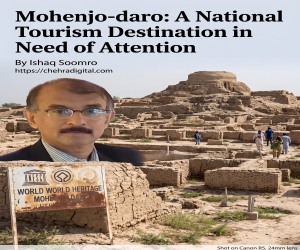
Mohenjo Daro
The earliest imprints of human activities in Sindh go back to the Paleolithic age, roughly between/before 400,000 and 200,000 B.C. Stone implements and cave paintings from this period have been discovered in many parts of the Sindh. Evidence of domestication of animals, the adoption of agriculture, permanent village settlements, and wheel-turned pottery dating from the middle of the sixth millennium B.C. has been found from many parts of Sindh.
The Indus culture blossomed over the centuries and gave rise to the Indus Valley Civilization around 3000 BC and spread as far south as the Arabian Sea coast of India in Gujarat, as far west as the Iranian border, with an outpost in Bactria. Among the settlements were the major urban centers of Mohenjo-Daro, Harrapa, Jhookar jo daro, lakhain jo daro etc: Among those all cities of Indus Mohenjo-daro ruins was the major centre of this civilizations which at its peak have had a population of over five million. The buildings of the city were particularly advanced, with structures constructed of same-sized sun dried bricks of baked mud and burned wood. Well-defined structures of old drains were discovered along with certain old artifacts during the digging. In all, these homes in city of Mohenjo-Daro daro were designed for privacy, introspection, family life, and for insulation from the outside bustle of the city streets. The overall impression is that Mohenjo-Daro was inhabited mainly by artisans and traders who collectively composed a large and successful middle-class society.
Fabric Material Founded from Mohenjo daro
History has various proofs to believe the Textile, Industry, Technical/printed Textile, Dyes & Chemicals, Machinery, Fashion, Apparel Technology, Retail, Leather, Footwear, beads, weights & measurement, Jewelry and General technologies rooted into soil of Sindhi centuries back. Indus Valley civilization thought to have mastered the art of making cotton fabrics as early as 3000 BC where the Cotton was spun, woven, and dyed for clothing. Block printing of fabric by hand is an art practiced by Sindhi artisans for the enjoyment of owners of those fabrics throughout the world, perhaps therefore historians called Mohenjo daro as “city of brightly colored dresses”. The thin bronze needles of different sizes founded from Mohenjo Daro are believed to have meant for embroidery, sewing, needlework, stitching, striping, edging, needlecraft needlepoint on cloth which can be traced to ancient roots in the Sindh because the world's earliest known woven cotton cloth was found at 5000 year old Mohenjo daro site in Sindh where cotton cultivation is still a major farming practice. As the cotton trade was very important in the Indus Valley so perhaps hand woven fabrics became the leading industry and export for Mohenjodaro inhabitants. It was second only to the farming that thrived around Mohenjo-Daro.
The most frequents motifs were fruits, geometrical designs, crossing lines, boats and birds used in Sindhi fabrics shown in terracotta figurines, pottery and other things. Inspiration comes from the observation of the exuberant vegetation and fauna in Sindh. For instance grenada is a very common motif in chintz: grenada is a symbolic fruit meaning prosperity and wealth. Chintz from Persia use often different motifs: Tigers, lions and eagles (symbol of strength and power), camels, peacock (symbol of wealth), doves (symbol of peace), rats and goats. Many Sindhi textile designs influenced other civilizations.
The pieces of the cloth founded from Mohenjodaro have been undertaken to examination by Indian Central Cotton Inquiry Committee who said in their report that "This cloth is made of best kind of cotton and Indus knitters were superlative at their work and they had fashioned numerous techniques of cloth weaving"". Historian has many other undeniable proofs about this fact that cotton was first grown and been used by Mohenjodaro inhabitants such as that “Avara’s seal, a horned bull founded from Mohenjo daro looked very fine resting against his colorful cotton robe” of the bust of a king priest excavated from this city shows him draped over one shoulder in a piece of cloth. It is decorated with a trefoil pattern (like a three leafed clover) interspersed with small circles, the interiors of which are filled with a red pigment. The same trefoil pattern has been discovered in cities of Sumerian civilization whereas on the royal couch of Tutankhamen was also inscribed (of the ancient Pharaohs). The trefoil is a symbol of three sun-disks amalgamated together to symbolize the harmony of the gods of the Sun, water and earth.
Not only through ancient world but it is also confirmed that before 1000 AD: India and China trade fabrics. Around 1300 AD: Chou Ta-kuan, the Chinese observer of life at the Khmer capital of Angkor wrote that "preference was given to the Indian weaving for its skill and delicacy." 1550 AD: Indian printed cotton fabrics were sold to Japan by Portuguese. The Aztec civilization used naturally colored brown cotton as a principal form of payment. Greek and Roman civilizations used cotton for awnings and sails as well as clothing. Australia and Egypt produce the best quality cotton in the world but later on Sindhis.
Species of Cotton
There are 43 species of cotton among which 37 cotton species are from the old world viz: Asia, Africa and Australia whereas six from the new world viz: North and South America, Hawaii and the Galapagos Islands. Four cotton species have been domesticated around the world among which Gossypium herbaceum was cultivated by the Indus Valley civilization in South Asia, Gossypium hirsutum by the Maya civilization in Central America, Gossypium barbadense by the Inca civilization in South America and fourth Gossypium aboreum was disciplined by the Egyptian civilization in North Africa.
Process of Block printing
The process of block printing takes time, team work and, especially, skill. The three main tools of a block printed fabric are the wooden blocks, the fabric and the dye. It can take five carvers up to three days to create an intricate design in a block of teak for use as a printing block. The printers may use up to 30 blocks to complete a design. Separate blocks are required for each of the colors used in a design and it is not unusual to have four or five colors in a professional design. It can take twenty people, each doing a separate task, up to eight hours to prepare a single block printed garment. With all this, the results can only be unique and it seems this process of block printing has been used for centuries and is still in vogue.
The process of block printing begins with the wooden blocks. Wood carvers cut designs into blocks of different shapes and sizes. The top of the block has a handle for the printers to grasp. Each block has two or three cylindrical holes through it to permit the passage of air and to allow excess dye to squeeze out. There are also various points carved into to block which the printers use as placement indicators as they pick the block up and move it to the next patch of fabric. Each block is soaked in oil for one and one half to two weeks to soften the wood. The next step in the process is the arrangement of the fabric. Workers stretch 24 layers of jute taut over a long rectangular table. The jute serves as a pad to provide resiliency to the printing surface. The workers secure the fabric to the jute pad with pins, keeping it tightly in place.
When the printers are ready to do the printing, they select from three approaches. In the first method, called discharge printing, the printer dyes the fabric first. Then the printer chemically removes the dye from the portions of the cloth which will take the design. The bleached sections are treated, and then dye is reapplied to create the block print design. In the second method, also known as direct block printing, the cloth is bleached, and then dyed whole. The background color remains as the printer proceeds to print designs onto the dyed fabric using the wooden blocks. Finally, in resist printing, the block is used, not to apply dye, but rather to apply an impermeable resist, which can be made of clay, resin or wax. When the cloth is dyed, the portions covered by the resist do not take the dye. The resist is removed and the design has been created in reverse.
Printing is done from left to right. When the printer is using the discharge or direct block print methods, the printer dips the block into the dye then presses it onto the fabric. The printer slams the back of the block hard with the fist to create a clear impression. Then the printer moves the block to the next portion of fabric to be dyed, using points on the block to serve as a guide for the placement of the block. As they work, the printers pull a wooden cart bearing their blocks along with them. The wooden blocks can be interchanged from one piece of fabric to another, creating different patterns. Custom designs and different colors can be used from one fabric to another, creating still more individual work.
Each color of a design is done by a different printer, coming behind the one before and repeating the process. The process requires teamwork, as each subsequent printer must place the block accurately to create a beautiful, whole pattern. Once the pattern is finished on the whole length of fabric, the piece is treated to fix the dyes. First, the fabric is dried in the sun. Once dried, the fabric is rolled in newspapers and steamed in special boilers. After steaming, the fabric is washed, dried in the sun again, and ironed. Each of these steps contributes to fixing the pigment and making the colors rich and vibrant.
Dyeing and its process
Dyeing is the method of imparting colors to textile stuff in loose fiber (yarn) a long incessant length of interlocked fibers, appropriate to textile, sewing, crocheting, knitting, weaving, needlework and rope making production. Thread is a type of yarn intended for sewing by hand or machine. Dye can usually be described as a colored material that has a similarity to the substrate to which it is being applied. The dye is commonly applied in an aqueous solution, and may necessitate a caustic to develop the fastness of the dye on the fiber
It is provide as true by historians that from thousands of years dyeing has been used by human being for them selves to decorate clothing, a wide variety of material that cover the human body. Volumes of anthropology, history and archaeology reveals that very first use of cloth occurred in Indus Valley civilizations where traces and pieces of cloths have been founded while excavation of Mohenjodaro.
The most important resource is nature which in the broadest sense is comparable to the natural, physical, or material world. "Nature" refers to the phenomenon of the physical world and also to life in general. As the dyes being took out from animals a major group of mostly multicultural, eukaryotic organisms of Animalia or Metazoa kingdom. Their body plan ultimately became fixed as they develop, although some undertaking of metamorphosis later on in their life.
There are many forms of yarn dyeing. Common forms are: at package form and at hanks form. Cotton yarns are mostly dyed at package form, and acrylic or wool yarn are dyed at hank form. In continuous filament industry, polyester or polyamide yarns are always dyed at package form, viscose rayon yarns are partly dyed at hank form because of technology.
Early evidences of dyeing came from Sindh bordered by the Indian Ocean on the south, the Arabian Sea on the west, and the Bay of Bengal, where a piece of cotton dyed with a vegetable dye has been recovered from Mohenjo-Daro an archaeological site of 3rd millennium BC, where the form of dye used was madder. Mohenjo-daro was one of the largest city-settlements of the Indus Valley Civilization of south Asia situated in the province of Sind, Pakistan. Built around 2600 BCE, the city was one of the early urban settlements in the world, existing at the same time as the civilizations of ancient Egypt,Rubia is a genus of the madder family Rubiaceae, which contains about 60 species of perennial scrambling or climbing herbs and sub-shrubs native to the Old World, temperate Asia, Africa, and America.
Dying in Mohenjodaro
Dyeing cotton fabrics is an ancient Sindhi art and the technique of dyeing cotton fabric and the patterns are traditional which has been used fabric trade which goes back to the Phoenicians who are believed to be the first foreign merchants to come here and what attracted them most were Sindhi cotton fabrics.
This proves that cotton cultivation has begun in subcontinent, but it spread over a wide geographical region. From early times this silk was regarded as a sumptuous fabric, while cotton played a more utilitarian role in Indus societies. The major problem with silk is that it requires delicate handling during the process of reeling so as to get a uniform thickness. With cotton the problem involves bonding the dye to the fiber. To absorb the dye, cotton fiber has to be treated with a variety of substances, so that the desired color ingredients can penetrate the fiber and become permanently insoluble.
Mordanting techniques Treatment of a fabric before it is dyed is known as mordanting and Sindhi mastery over this process gave Sindhees finished products dominance in the trade. Some of the major mordanting centers in subcontinent were in Mohenjo daro, Gujarat and at Masulipatnam, Kalahasti, Pulicat and the Tanjore region on the Coromandel Coast. At these centers Indian artisans developed and perfected various techniques of dyeing decorative patterns on cotton using vegetable colors.
Basic techniques for mordanting cotton varied only in that in Mohenjodaro were on the Coromandel Coast the transfer technique and the brushes or pens were preferred. After examining the designs of fabrics and shops research understand that each market had its own layout, motifs and color and these had to be adhered to rigidly in order to ensure successful sale. Sindhi cottons were sold in all ancient known Gulf ports and regions while prime outlets for it were Egyptians, Mesopotamian, Mayan and Chinese regions.
The technique incorporates patterns on fabrics through dyes and not through the loom. Ochre is a color that cotton takes on easily, but for other colors to be absorbed the fabric has to undergo mordanting as the chemical reactions that follow would allow cotton fibers to absorb the desired hue. A fragment of mordant-dyed cotton fiber founded in Mohenjo daro is proof of the antiquity of the process.