National and International academicians talk on integrating sustainability into higher education at Sindh Madressatul Islam University
 Chehra WebDesk
Karachi The distinguished academicians of
Pakistan, Russia, USA and UK have shown their concerns on decreasing natural
resources and increasing consumption of natural resources including natural
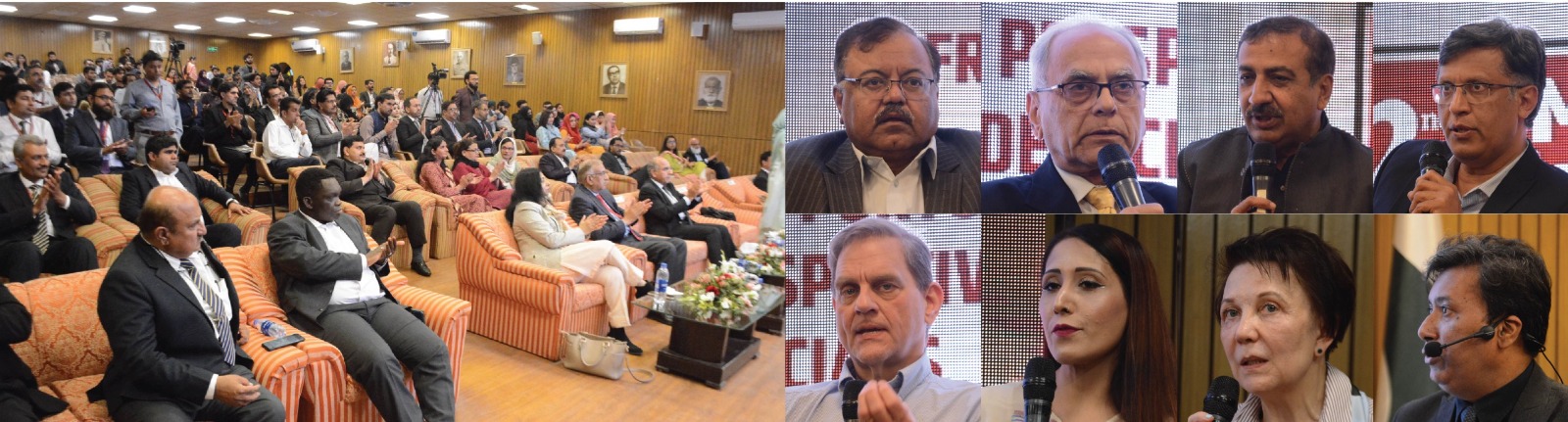
gas, water and growing population. Speaking at a session on “Integrating
Sustainability into Higher Education: Challenges and Opportunities from the
Perspective of Academicians” at Sindh Madressatul Islam University (SMIU) they
said the sustainability is much needed at all levels in for development. They
suggested that each and every one should contribute in sustainability in
his/her field individually and collectively and sustainability must be made a
part of curriculum of higher education also.
Former Vice Chancellor and present Pro-Vice
chancellor of Mehran University of Engineering and Technology, Jamshoro Dr.
Muhammad Aslam Uqaili said that the resources we are using are no more
sustainable and using these on the cast of our future generation. He said
development has the cast to pay, when we are developing our countries we are
not considering how we can provide sustainability to our resources. Dr. Uqaili
said we have much used our energy resources as a result even in Karachi, its
citizens are facing shortage of natural gas. He further said that we are
looking to reuse and recycle the waste materials, but Germany has now gone to
the zero waste. Dr. Uqaili further said we believe that universities are agents
of change, and these are producing human resources to the society, therefore,
for sustainability we have to provide capacity building trainings to youth for
sustainability.
Dr. Manzoor Hussain Soomro, ECO Science
Foundation said people need to be educated about sustainability and they need
to know what are the factors affecting our environment and what the skills and
technologies are required to achieve the sustainability without going into SDGs
and targets. He said education as well as SDGs 4 and 5 emphasized that
education should be across the board and for all. Therefore, there is a need to
transform the society according to the way we think and the way we are groomed.
He said to achieve the targets we should go back to early child education, then
building the building of tertiary education and then higher education. He suggested that in this respect we have to
engage the HEC to bring school children, university students, faculty,
industry, media and all the stake holders at one platform to play their major
role. Dr. Soomro said we are working in
isolation, but everyone must be resilient at these issues and in this respect
science education is most important.
Dr. Keith Casey Barton, Professor at Indiana
University, USA said that in American universities everything is centralized.
The American government cannot say anyone to concentrate on these goals. Even
chancellor or pro-chancellor cannot say to do that. He was of the view that the
sustainability is a long and slow process, but we should do focus on the
sustainability for our secure future.
Dr. Fateh Mohammad Marri, Vice Chancellor of
the Sindh Agriculture University, Tandojam talked on the food sustainability
and said we know that our natural resources, land, water and forest reservoirs
are limited, on the contrary population is growing, therefore demand for food
has increased. He said because of change in consumption pattern and
urbanization there is a huge pressure on natural resources. Now we have to meet
the requirements of the current population and current need of the country
without compromising on our future need and without compromising on the
interests of future generations. Dr. Marri said integration of the
sustainability in higher education is also important. He suggested that now the
task is to improve production and productivity. Higher education also needs
sustainability. “Around 03 percent of our illegible cohort gets in higher
education and 90 percent is still out of higher education,” Dr Marri said and
added that we have to make education sustainable for all children.
Dr. Jawad Syed, Professor at the Lahore
University of Management Sciences (LUMS) said that it is important at the
university level that we should revisit our priorities, because for these all
things students are not responsible, they are our product, hence we have to
look at our KPIs (key performance indicators) that how many courses are
carrying sustainability.
Ms. Shajara Ul Durar, Associate Professor at
the University of Sunderland, UK said that we need to empower students by
giving them projects and the education leadership has to take responsibility of
all things. She said presently more than 50 percent female students are
studying in UK’s universities, despite that fact all universities are trying to
have more number of female students. At the same time, they are working on
gender equality. She suggested that
educational institutions should take responsibility to publish social impact
reports and that should be made a part of the academia.
Dr. Solnyshkina Marina Ivanovna, Professor of
Linguistics at the Kazan University of Russia narrated her success story and
social and educational conditions in the period of Soviet Union and at present.
She informed that how she got education in German language and then in English
language, because there was a school near to them, where medium of instruction
was German language, that is why she got admission in that school and
thereafter, she changed language from German to English, that enlarged her wisdom. She said that in the educational institutions
of Russian Federation mixed courses are being taught to students. She further
said without any gender difference we have to contribute to our society and its
sustainability. She said her country Russia is rich in natural resources and
has brought sustainability in its all areas.
Dean Faculty of Management, Business
Administration and Commerce of SMIU Dr. Jamshed Adil Halepoto moderate the
session.
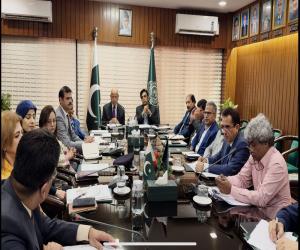
The session was attended by Chairman Sindh HEC
Dr. Tariq Rafi, Vice Chancellor of SMIU Dr. Mujeeb Sahrai, national and
international scholars, SMIU’s faculty, heads of different academic and
administrative departments and students. In the end of the session Dr. Mujeeb
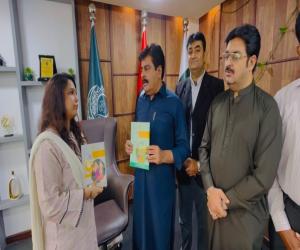
Sahrai gave away souvenirs to the guests.