Fight Against Gender-Based Violence"
 Imran
Imran
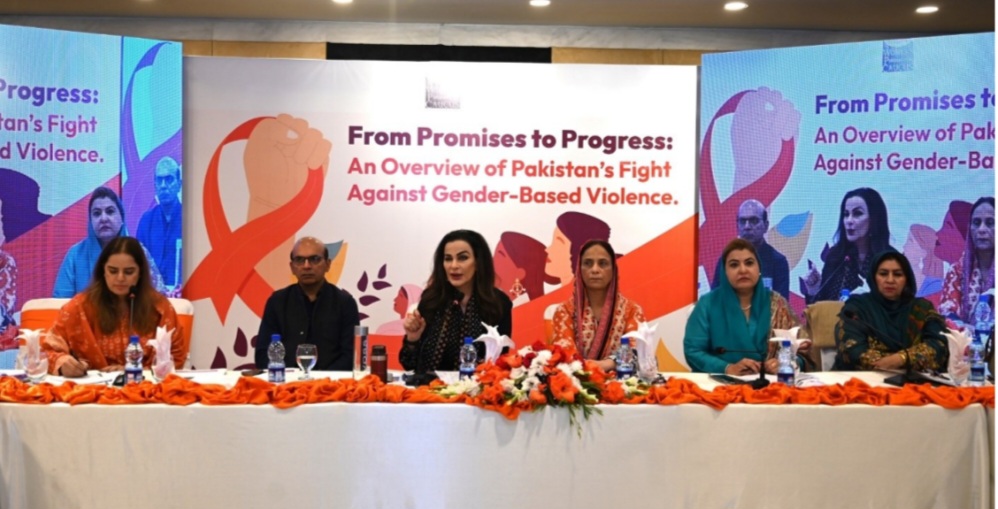
Round Table Discussion on "From Promises to Progress: An Overview of Pakistan's
Fight Against Gender-Based Violence"
Islamabad, Women Parliamentary Caucus (WPC) in collaboration
with the Centre for Peace and Development Initiatives (CPDI) held a significant round table
discussion titled "From Promises to Progress: An Overview of Pakistan's Fight Against
Gender-Based Violence" at the National Assembly. The event brought together a diverse
group of stakeholders, including civil society members, prominent women
parliamentarians, legal experts, students and young activists to address the pressing issue
of gender-based violence (GBV) in Pakistan.
The event commenced with introductory remarks by the Executive Director of CPDI, Mr.
Mukhtar Ahmad Ali, who highlighted the persistent issue of gender-based violence in
Pakistan despite the existence of numerous laws. The speaker emphasized the need to
bridge the gap between legislation and implementation, particularly addressing structural
violence embedded within societal norms and institutions.
Dr. Shahida Rehamani, Secretary of the Women's Parliamentary Caucus (WPC),
underscored the significance of the WPC as a platform for advocating women's rights and
promoting gender-sensitive legislation. She highlighted the importance of media in raising
awareness about GBV and the crucial role of women parliamentarians in championing women's rights.
The Chief Guest, Senator Sherry Rehman, President of the Pakistan National Group of the
Parliamentarians for Global Action (PGA), emphasized the importance of rigorous data
collection and research to understand the true extent of GBV in Pakistan. She highlighted the
alarming rates of honor killings, acid attacks, and domestic violence, urging for stronger
implementation of existing laws and the development of new legislation to address emerging
forms of GBV.
Ms. Saba Sadiq, Member of the National Assembly, addressed the issue of systemic
discrimination against women and girls. She highlighted the need to challenge patriarchal
norms and promote gender equality at all levels of society. Sadiq emphasized the
importance of sensitizing law enforcement agencies and the judiciary to effectively handle
GBV cases.
Ms. Shehla Raza, Member of the National Assembly, emphasized the need for a holistic
approach to combat GBV, addressing both structural and individual-level factors. She
advocated for greater awareness and sensitization campaigns, as well as stricter
enforcement of existing laws. Ms Shehla also highlighted the importance of empowering
women through education and economic opportunities.
Ms. Ghazala Gola, Deputy Speaker of the Provincial Assembly of Balochistan, shed light on
the unique challenges faced by women in Balochistan, particularly in terms of cultural and
societal norms that perpetuate GBV. She shared her efforts to raise awareness about GBV
and advocate for legal reforms at the provincial level. Ms. Ghazala emphasized the
importance of community engagement and the role of religious leaders in promoting positive
attitudes towards women.
Ms. Fauzia Viqar, Federal Ombudsperson for Protection Against Harassment of Women at
the Workplace, discussed the role of ombudsperson offices in providing redressal
mechanisms for victims of workplace harassment. She highlighted the challenges faced by
victims in accessing justice and called for increased awareness and support services.
Dr. Yusra Gillani, a disability rights activist, emphasized the need for inclusive policies that
address the specific needs of women with disabilities. She highlighted the intersectional
nature of discrimination faced by women with disabilities and called for greater attention to
their rights.
Ms. Tanzeela Mazhar, a renowned journalist, writer, and anchor, discussed the role of media
in shaping public discourse on gender-based violence. She highlighted the importance of
responsible journalism and called for media outlets to avoid perpetuating harmful
stereotypes and victim-blaming.
Ms. Umme Laila Azhar, Acting Chairperson of the National Commission on the Status of
Women (NCSW), highlighted the Commission's efforts to digitize data on GBV to inform
evidence-based policymaking. She added that the NCSW is set to launch a national portal
in March 2025 to provide comprehensive data and analysis on GBV trends and patterns.
Ms. Tahira Aurangzeb, Member of the National Assembly, concluded the event by
emphasizing the need for multi-stakeholder collaboration to address GBV. She called for
increased coordination between government agencies, civil society organizations, and
international partners to develop comprehensive strategies to prevent and respond to GBV.
Ms. Nowsheen Khurrum and Ms. Sarwat Jahan from CPDI thanked the participants for their
valuable insights and reiterated the importance of the Domestic Violence Bill, urging women
parliamentarians to expedite its approval in the National Assembly.
The round table discussion concluded with a strong call to action for policymakers, law
enforcement agencies, civil society organizations, and the general public to work together to
create a safer and more equitable society for all.
About CPDI: The Center for Peace and Development Initiatives (CPDI) is a non-profit organization committed
to promoting peace, development, and human rights in Pakistan. CPDI works on key public health issues,
environmental sustainability, education, and social justice, with a focus on advocating for policies that improve
the health and well-being of communities across Pakistan.