Book Review: Architecture of Caste in Pakistan: Dalit Assertions in a Culture of Denial by Ghulam Hussain
 Chehra WebDesk
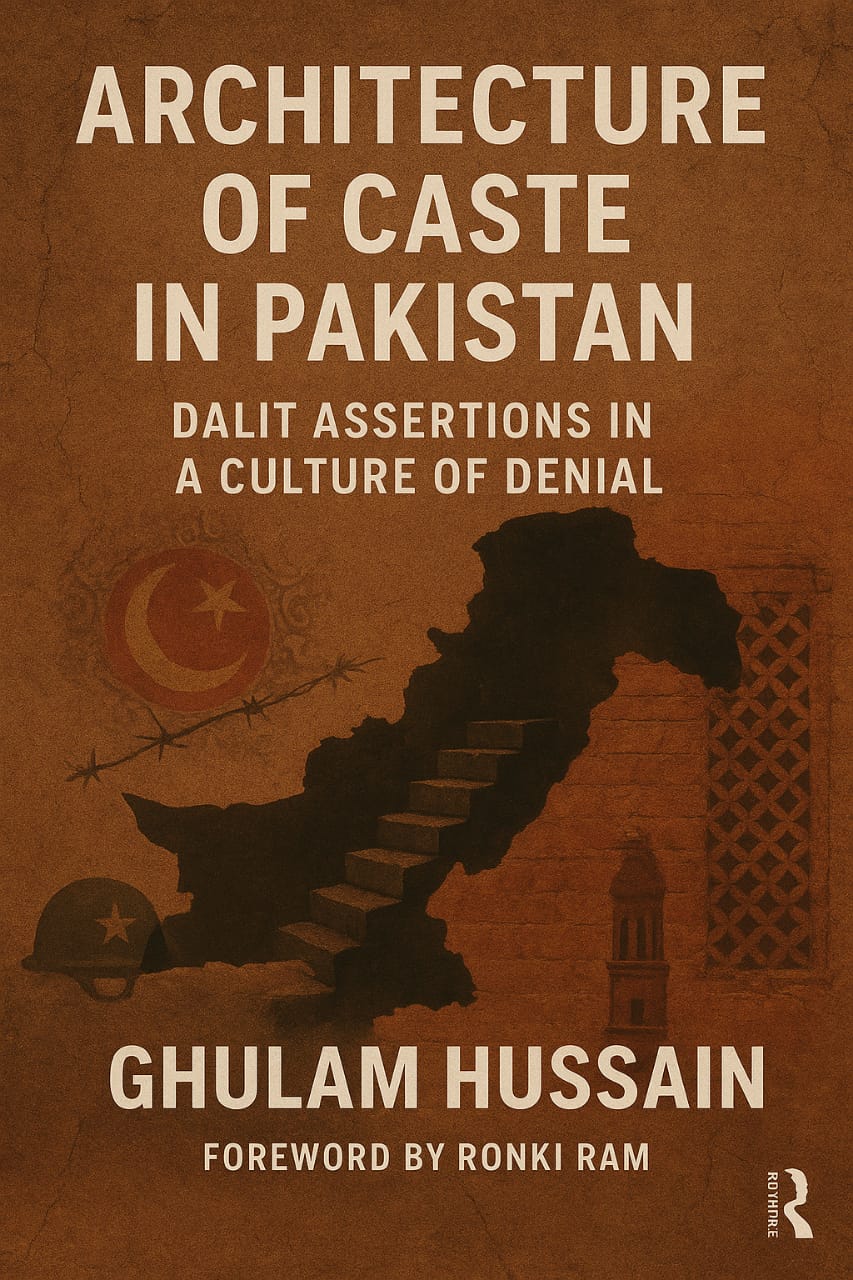
Ghulam Hussain’s Architecture of Caste in Pakistan: Dalit Assertions in a Culture of Denial is a monumental and urgently needed intervention into the study of caste, South Asia, and Muslim societies. Challenging the widespread denial and erasure of caste dynamics in Pakistan—often obscured by nationalist, religious, and liberal-progressive discourses—Hussain provides a rigorously researched and deeply ethnographic account of how caste continues to function as a fundamental, transreligious social structure across Hindu, Muslim, and Christian communities.
The book excels by moving beyond the familiar frame of Indian caste studies, demonstrating convincingly that in Pakistan, caste is neither a 'relic of the past' nor solely a 'Hindu problem,' but a deeply entrenched system that shapes everyday hierarchies, moral imaginaries, and political structures. Hussain’s meticulous fieldwork, primarily in Sindh, uncovers the 'underside of the tapestry,' revealing a landscape rife with caste discrimination, untouchability, unfair wages, and intensely inequitable economies—a profound counter-narrative to the state's claimed egalitarian socio-political view.
Key Contributions and Analysis
Dismantling Denial and Erasure: The central premise, addressed in Chapter 1, is the "culture of denial" and "epistemic violence" surrounding caste in Pakistan. Hussain shows how hegemonic actors—religious, nationalist, and secular—strategically deny or reassert caste to preserve structures of privilege.
Transreligious Grammar of Caste (Chapter 3): This is one of the book’s most groundbreaking contributions. Hussain demonstrates the "Architecture of Privilege" by showing how an Ashraf Caste Hegemon was created and sustained. Concepts like 'Everyday Sayedism' and 'Posthumous Ashrafization' illustrate how high-caste groups construct sacred genealogies and symbolically expropriate Dalit saints to solidify their authority. The analysis foregrounds caste as an analytic category and fundamental marker of identity, effectively demythologizing the idea of a purely egalitarian Islamic social structure in Pakistan.
Architecture of Erasure, Violence and Denial (Chapter 4): The book explores the mechanisms of minoritisaton and 'Hinduisation' that work to deny Dalitness among Muslims and Christians, confining the problem within a religious binary. It offers a critical perspective 'Beyond Forced Conversion Narrative,' focusing instead on the systemic violence and "logic of spiritual inequality" that perpetuates discrimination.
Politics of Naming and Belonging (Chapter 5): Hussain delves into the "Strategic Essentialism" and identitarian claims of oppressed groups, examining the complex afterlife of the 'Scheduled Castes' category and the struggle for a unified 'Dalit' framework amidst diverse groups defined by ethnicity, religion, and geography.
Biopolitics of Representation (Chapter 6): The analysis of the Census as a 'Site of Struggle' and the trajectory of Dalit political exclusion from electoral politics—examining the shift from separate to joint electorates—is crucial. Hussain exposes the mechanisms of tokenism and Ashraf patronage that sustain disparities in governance and limit genuine representation.
Dalit Assertions and Resistance (Chapter 7): Moving beyond critique, the book highlights acts of agency. It documents the making of 'Ambedkarite Sindh' and the role of groups like Dalit Sujaag Tehreek (Dalit Awakening Movement) as the vanguard of anti-caste resistance. This chapter explores the pragmatics of strategic mobilization and the calls for structural redress.
Toward a Transreligious Reckoning (Chapter 8): The conclusion is a powerful call for a "critical transreligious anti-caste epistemology" and the possibilities of Dalit-Pasmanda solidarity that transcends binary thinking and reckons with erasure.
Significance and Audience
Hussain’s work is characterized by its theoretical sophistication coupled with moral and ethnographic engagement. It compels scholars to fundamentally rethink caste, religion, and equality in Muslim societies and across South Asia. The book is not merely academic; it is, as one reviewer notes, a "call to action"—a crucial foundation for anti-casteist, anti-capitalist, and decolonial political action and theory.
This volume is essential reading for scholars and researchers of caste and discrimination studies, critical Dalit and Pasmanda studies, sociology, social anthropology, and South Asian studies. It is a ground-making intellectual and political achievement that lends crucial legibility to the necessary work of anti-caste scholarship coming from Pakistan. The sheer weight of its empirical evidence makes it a book that will be difficult to ignore.