The Sage of Saan: Two Days with the Architect of Sindh’s Modern History
 Ishak Soomro
G.M. Syed was a towering Sindhi politician, thinker, and researcher who played a decisive role in the political, academic, literary, and social history of Sindh. He remained actively involved in Sindhi politics throughout his life—from the separation of Sindh from the Bombay Presidency, to the 1943 resolution of the Sindh Assembly in support of Pakistan, and even after participating in the 1970 general elections. Until his death, he continued to speak fearlessly, advocating what he believed was the true future of Sindh.
Beyond politics, G.M. Syed made immense contributions to Sindhi history and literature. His notable works include Payam-e-Latif, Janab Guzariyam Jinsan, Jain Detho Mon, and many others. These writings alone secure his place as one of the most influential Sindhi intellectuals of the 20th century.
I had known G.M. Syed’s name and stature since childhood. Sakrand and Saan have long been regarded as twin cities of Sindh, separated by Mehrabpur village, Pai Jungle, and the Indus River. G.M. Syed’s agricultural lands, political influence, and social connections—particularly with figures such as Syed Imdad Muhammad Shah, Ameer Haider Shah, and Zain Shah—remain deeply rooted in Sakrand to this day.
His political influence extended across Sakrand taluka and its surrounding areas. Among his closest associates was Syed Hassan Bakhsh Shah, the grandfather of the current Member and Deputy Speaker of the National Assembly, Syed Ghulam Mustafa Shah. Due to his close association with G.M. Syed, Syed Hassan Bakhsh Shah was elected to the Sindh Assembly several times and was widely regarded as G.M. Syed’s right-hand man.
I first heard about G.M. Syed from my grandfather, Muhammad Fazal Soomro, who served in the postal department during the British era. He always referred to him respectfully as “Jem Shah,” a title still used by Sakrand’s elders. My grandfather would travel long distances to deliver letters to him and would narrate stories of his character and influence. Listening to these stories, I developed a strong desire to meet this great leader of Sindh.
Every year on January 17, G.M. Syed’s birthday was celebrated in Saan, and I was fortunate to attend several of these gatherings. The journey itself was unforgettable—traveling early in the winter morning to Mehrabpur by jeep or bus, walking through the jungle, crossing the Indus River by boat, and finally reaching Saan, where crowds moved toward the celebrations like pilgrims toward a sacred destination. Saan was synonymous with G.M. Syed; his presence defined the town.
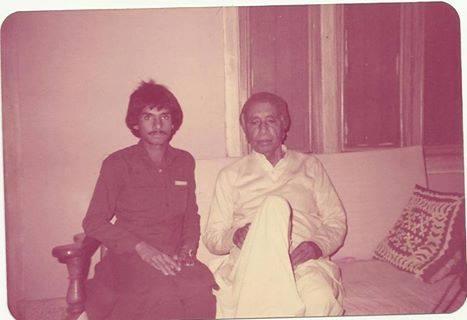
My first and only detailed meeting with G.M. Syed took place in December 1983 at his riverside bungalow in Saan.(43 years back) This meeting was made possible by my dear friend Dr. Shabbir Memon, who sadly passed away at a young age. Along with him were two of my childhood friends: Pir Hamdullah, now the Sajjada Nashin of Dargah Khanyarvi Sharif, and Faiz Rind, then an active SPSF student leader at Mehran University/College Nawabshah and now an agricultural engineer in Khairpur.
G.M. Syed was well acquainted with Sakrand and its people. He asked Pir Hamdullah about his father and other elders and narrated several colorful incidents from his own life. He spoke at length about the MRD movement and the political situation in Sindh at the time. Referring to the brutal killing of 16 people by the army in Punhak Khan Chandio village of Sakrand, he described it as a consequence of power-hungry politics and remarked bluntly, “These people are dying for power. Why should we feel sorry for them?”
He expressed strong resentment toward the Pakistan People’s Party, calling its leadership enemies of Sindh and accusing them of hostility toward Sindhi political aspirations. He recalled meeting Begum Nusrat Bhutto and Benazir Bhutto at Al-Murtaza House in Larkana to offer condolences after the execution of Zulfikar Ali Bhutto. G.M. Syed told them plainly that Bhutto had been killed by Punjabis and urged them to speak for Sindh’s independence. Nusrat Bhutto remained silent, while Benazir Bhutto responded that her politics was aimed at preserving the federal structure of Pakistan.
Speaking about Sindhi–Muhajir relations, G.M. Syed mentioned that migrant leaders such as Nawab Muzaffar Ali Khan frequently visited him in Saan. He believed that although migrants appeared politically scattered, they would eventually organize and move forward.
With a touch of humor, he remarked on the widespread hatred for General Zia-ul-Haq in Sindh, joking bitterly about the irony of Syed Imdad Muhammad Shah naming his son after Zia. He took us on a tour of his impressive library, where photographs of prominent Sindhi leaders—including Zulfikar Ali Bhutto—hung on the walls. “History cannot deny their importance,” he said.
Every room in his bungalow was equipped with telephones and air-conditioning, and the library shelves were arranged with remarkable sophistication. During our stay, he excused himself for prayers. Out of curiosity, I later asked him whether he prayed regularly. After a brief silence, he replied simply, “Yes… I have become accustomed to it.”
We asked him several questions about how Sindh would be governed after independence—whether it would be democratic, socialist, or something else. He replied that such questions would be addressed after independence itself. It was clear that we were neither party workers nor ideological followers, and at times his tone toward us grew sharp. Student leaders of Jeay Sindh, including Dodo Mahari and Ghulam Mustafa Shah (Thatta), who were present, seemed to enjoy the lively and occasionally tense exchange.
By nature, G.M. Syed was refined, intellectual, and deeply hospitable. At that time, Saan had no hotels or restaurants. He used to say, “Whoever comes to Saan is my guest,” a powerful reflection of Sindh’s tradition of hospitality. One of his most admirable traits was personally seeing off every guest at the front door, a practice he insisted upon despite our repeated requests not to trouble himself.
I was fortunate to spend two days with this extraordinary man, take photographs with him, and listen to his unfiltered views on Sindh, Sindhis, Muhajirs, and resistance politics. At that time, my own understanding was limited. Over the years, I have read nearly all of his books and preserved files of his interviews and statements.
G.M. Syed was not only a great politician but also a profound writer. I believe he remains the only Sindhi political leader whose writings allow students of history to truly understand Sindh’s recent past through the eyes of someone who both made and recorded that history.
Professional Profile: Ishak Soomro
Ishak Soomro is a highly experienced professional specializing as a Journalist, Research Associate, and Columnist with a distinguished career spanning 15 years
He possesses extensive expertise in multilingual communication and analysis, having written and contributed across three major languages: Sindhi, Urdu, and English
ishaksoomro@yahoo.com