Economic Integration Only Path to South Asian Stability: Ikram Sehgal
 Irfan Ali

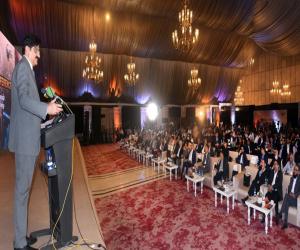
Karachi, Political and military options appear to be at a standstill, while economic integration remains the only “non-controversial” path to regional stability, said Ikram Sehgal, Co-Chairman of the Pathfinder Group, while talking at a discussion on the rapidly changing geopolitical landscape of the Subcontinent, at the second day of the Karachi Literature Festival (KLF) 2026.
The session was moderated by Dr Huma Baqai, Rector of the Millennium Institute of Technology and Entrepreneurship (MiTE).
Addressing a large audience on the theme “Shifting Balance of Power in South Asia”, Sehgal referred to his own unique historical background and described himself as belonging to “Pakistan and Bangladesh — two countries, one nation”.
Highlighting the untapped potential between the two states, he advocated for a borderless South Asian economy, beginning with Pakistan and Bangladesh and possibly, including Sri Lanka.
He called for the revival of Ziaur Rahman’s 1977 vision of “no visa, no tariff”, which later formed the basis of the South Asian Association of Regional Cooperation (SAARC). Ikram Sehgal also suggested compatibility between the Pakistani rupee and the Bangladeshi taka and said that Pakistani entrepreneurs played a significant role in the success of Bangladesh’s textile industry.
A key part of his address focused on the historic economic harmony between Punjab and Bengal, which he said, were known as the ‘granaries’ of South Asia before 1947. Although Pakistan is geographically linked to the region, it has been gradually pushed towards isolation due to what he described as the shortsighted political dominance of India’s BJP-led government.
Describing South Asia as a “blend of multiple civilisations”, Sehgal said that the region reflects Central Asian, East Asian and Middle Eastern influences, which are visible in its modern urban populations. Citing Karachi as an example, he observed that the city has developed ethnically divided neighbourhoods, including Lyari with its Sindhi/Baloch identity and areas dominated by Muhajir communities, similar to urban ‘ghettos’ in the West.
He stressed that understanding this diversity is necessary to overcoming the region’s current isolation.
“South Asia cannot be resolved militarily or politically, but it can be addressed economically,” he said, pointing to the complementary nature of regional resources. Referring to the rise of religious nationalism in India, he warned that exclusionary ideologies pose a threat to regional balance, with effects already being felt in Bangladesh, Sri Lanka and Nepal. While India seeks regional dominance, it is missing out on the benefits of cooperation that a collaborative Pakistan could offer to the world.
After May 9, the time had come to adopt a proactive rather than reactive strategy. Pakistan’s armed forces had demonstrated that power does not depend solely on size. According to him, May 9 exposed as India’s hollow claim of being the “policeman of the region” in the Indian Ocean. He urged Pakistan to shift its strategy instead of merely responding to Indian provocations.
Referring to Sam Dalrymple’s book Shattered Lands, which portrays India as a product of political manoeuvring and power struggles, Ikram Sehgal said that the time had come to support oppressed communities, particularly in the north-eastern regions. He also questioned why many Muslim-majority states remain silent over what he described as harsh policies against Muslims in India.
Speaking about the China–Pakistan Economic Corridor (CPEC), he described it as an important trade route for China and that American involvement in Pakistan was also necessary to maintain strategic balance and reduce overdependence on any single global power.
He noted that the newest of the United States Navy’s 11 aircraft carriers, the USS Gerald R. Ford, is 12 years old, whereas China’s four current carriers include one that is only four years old, with several more expected to become operational within the next three to four years. According to him, the United States would not want the Indian Ocean to become a “Chinese sea”.
Dr Huma Baqai praised Ikram Sehgal’s role as a bridge between Pakistan and Bangladesh. The discussion left students, business leaders and technology professionals in the audience with a message that the future of South Asia lies not in political ideology, but in economic realism.