July 5, 1977: The Coup That Changed Pakistan Forever
 Ishak Soomro
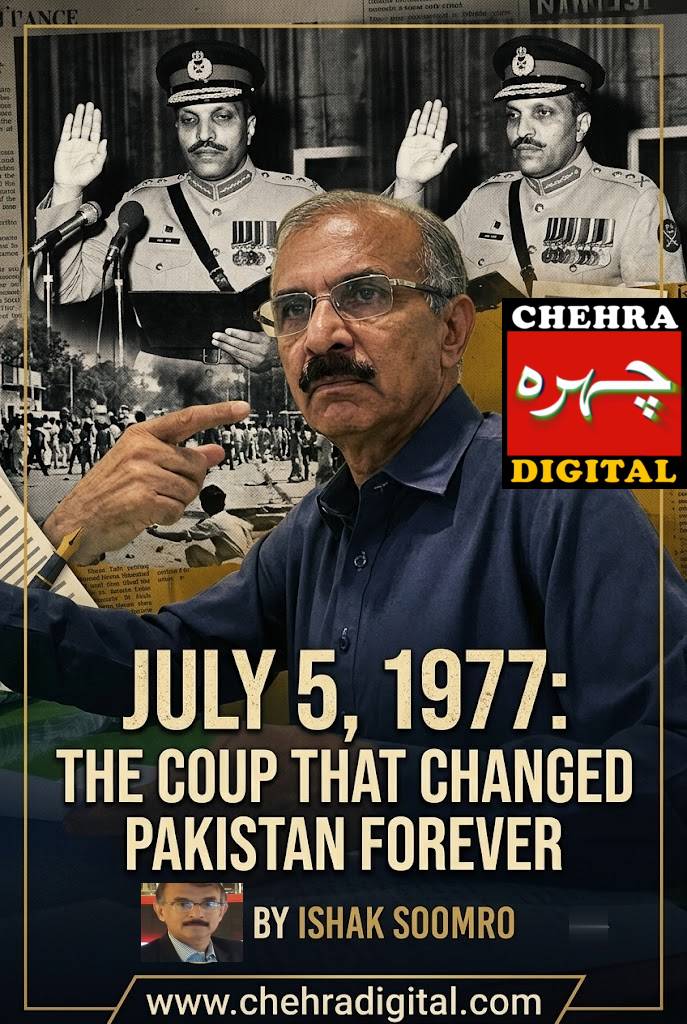
The overthrow of Prime Minister Zulfikar
Ali Bhutto on July 5, 1977, remains one of the most defining moments
in Pakistan's political history. The military coup, codenamed Operation Fair
Play, led by General Muhammad Zia-ul-Haq, brought an abrupt end to
five and a half years of elected civilian rule and ushered in an 11-year
military dictatorship. More than a simple transfer of power, the coup reshaped
Pakistan's political institutions, judicial system, foreign policy, and social
landscape, leaving a legacy that continues to influence the country nearly five
decades later.
Zulfikar Ali Bhutto assumed power in
December 1971 in the aftermath of Pakistan's greatest national tragedy—the
separation of East Pakistan and the creation of Bangladesh. At a time when the
country was struggling with political uncertainty and shattered national
confidence, Bhutto emerged as a charismatic and popular leader who promised to
rebuild Pakistan through democratic governance and social justice.
His slogan, "Roti, Kapra aur
Makaan" (Food, Clothing, and Shelter), resonated with millions of
ordinary Pakistanis. During his tenure, his government introduced wide-ranging
reforms, nationalized major industries, strengthened labor rights, and, most
significantly, gave the country its first unanimously adopted Constitution in
1973. Bhutto also laid the foundation of Pakistan's nuclear programme, a
strategic initiative that would shape the country's defense policy for decades.
Yet despite these achievements, his
government increasingly faced criticism over authoritarian tendencies,
suppression of political opponents, and growing economic challenges.
In March 1977, Bhutto called general
elections seeking a renewed public mandate. The Pakistan People’s Party (PPP)
secured an overwhelming victory. However, the opposition alliance—the Pakistan
National Alliance (PNA), comprising nine political parties—rejected the
election results, alleging widespread rigging and electoral fraud. The
accusations quickly ignited a nationwide protest movement.
Large-scale demonstrations, strikes,
civil disobedience campaigns, and violent clashes spread across the country.
The government responded by imposing martial law in several major cities in an
attempt to restore order. Although negotiations between the government and the
opposition continued for weeks and reportedly made progress, the political
crisis deepened, creating an atmosphere of uncertainty.
Before dawn on July 5, 1977,
Chief of Army Staff General Muhammad Zia-ul-Haq launched Operation Fair Play.
Military forces swiftly occupied key government buildings, communication centers,
and strategic installations across the country. Prime Minister Bhutto, members
of his cabinet, and several opposition leaders were taken into custody.
Ironically, General Zia had been
elevated to the position of Army Chief by Bhutto himself, superseding several
senior generals.
Addressing the nation after the
coup, He assured Pakistanis that the armed forces had intervened only
temporarily and promised to hold free and fair elections within 90 days,
after which power would be transferred back to elected representatives.
Those elections, however, never took
place. Instead, Pakistan entered one of the longest periods of military rule in
its history, lasting until General Zia's death in 1988.
The military takeover was only the
beginning of Bhutto's political ordeal. He was arrested, released briefly, and
arrested again before facing trial on charges of conspiring to murder a
political opponent. The proceedings remained controversial from the outset,
attracting criticism from legal scholars, jurists, and international human
rights organizations. Despite appeals for clemency from world leaders and
international institutions, Bhutto was sentenced to death and executed on April
4, 1979. To many historians and constitutional experts, the verdict has
long been regarded as a judicial miscarriage that permanently scarred
Pakistan's legal and democratic history.
The July 5 coup fundamentally
altered Pakistan's national trajectory. General Zia introduced an extensive
programme of Islamization, reshaping the country's legal framework, education
system, and public institutions through religious legislation and
constitutional amendments. These reforms continue to influence Pakistan's governance
and society.
Internationally, Pakistan's
strategic importance increased dramatically after the Soviet invasion of
Afghanistan in 1979. Under General Zia, Pakistan became a frontline ally of the
United States during the Cold War. Billions of dollars in military and economic
assistance flowed into the country, while the Afghan conflict transformed
Pakistan's security environment in ways that continue to reverberate across the
region.
Domestically, political activity was
severely curtailed. Political parties faced restrictions, the press was
subjected to strict censorship, and many politicians, journalists, lawyers, and
activists were imprisoned or publicly flogged under martial law regulations.
The culture of political repression left lasting effects on democratic
institutions.
Nearly half a century after
Operation Fair Play, the events of July 5, 1977, continue to shape Pakistan's
political discourse. The coup entrenched the military's role in national
politics and established a pattern of civil-military imbalance that has
repeatedly resurfaced throughout Pakistan's history. It also deepened political
polarization, with supporters viewing Zulfikar Ali Bhutto as a symbol of
democratic resistance. The debate over the events of July 1977 remains far more
than a historical discussion. It continues to influence constitutional
development, democratic governance, judicial independence, and civil-military
relations in contemporary Pakistan.
As the country reflects on one of
the most consequential chapters in its history, the lessons of July 5 serve as
a reminder that the strength of democratic institutions ultimately depends not
only on constitutions and elections but also on an enduring commitment to the
rule of law, political dialogue, and civilian supremacy.
Ishak Soomro is a journalist, columnist, and development
professional with more than 15 years of experience in journalism, research, and
the development sector. He writes extensively in English, Urdu, and Sindhi,
covering public policy, governance, socio-economic development, and the
political history of Pakistan.