"Empowering Pakistan's Youth: Building a Fairer Future Through Knowledge and Advocacy."
 Imran
Imran
"Empowering Pakistan's Youth: Building a Fairer
Future Through Knowledge and Advocacy."
Karachi, Pakistan -Training young workers in
Pakistan on industrial relations and labor laws would bring about positive
outcomes: improved rights understanding, decent work promotion, reduced
exploitation, enhanced negotiation skills, and future leadership capacity
building. This benefits individuals and fosters a more inclusive, equitable,
and sustainable labor market and society.
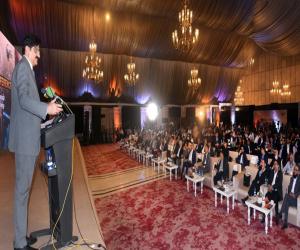
Chief Guest Muhammad Omer Soomro, Caretaker
Minister for Law, Religious Affairs, and Human Rights in Sindh, highlighted the
universal nature of the labor movement and its historical context. He stressed
the gap between labor laws and workers' experiences, urging participants to
implement their training actively. Soomro encouraged familiarity with Supreme
Court judgments on labor rights for valuable insights.
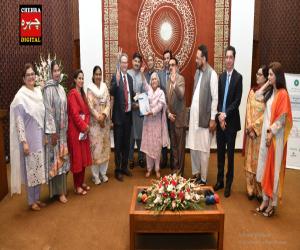
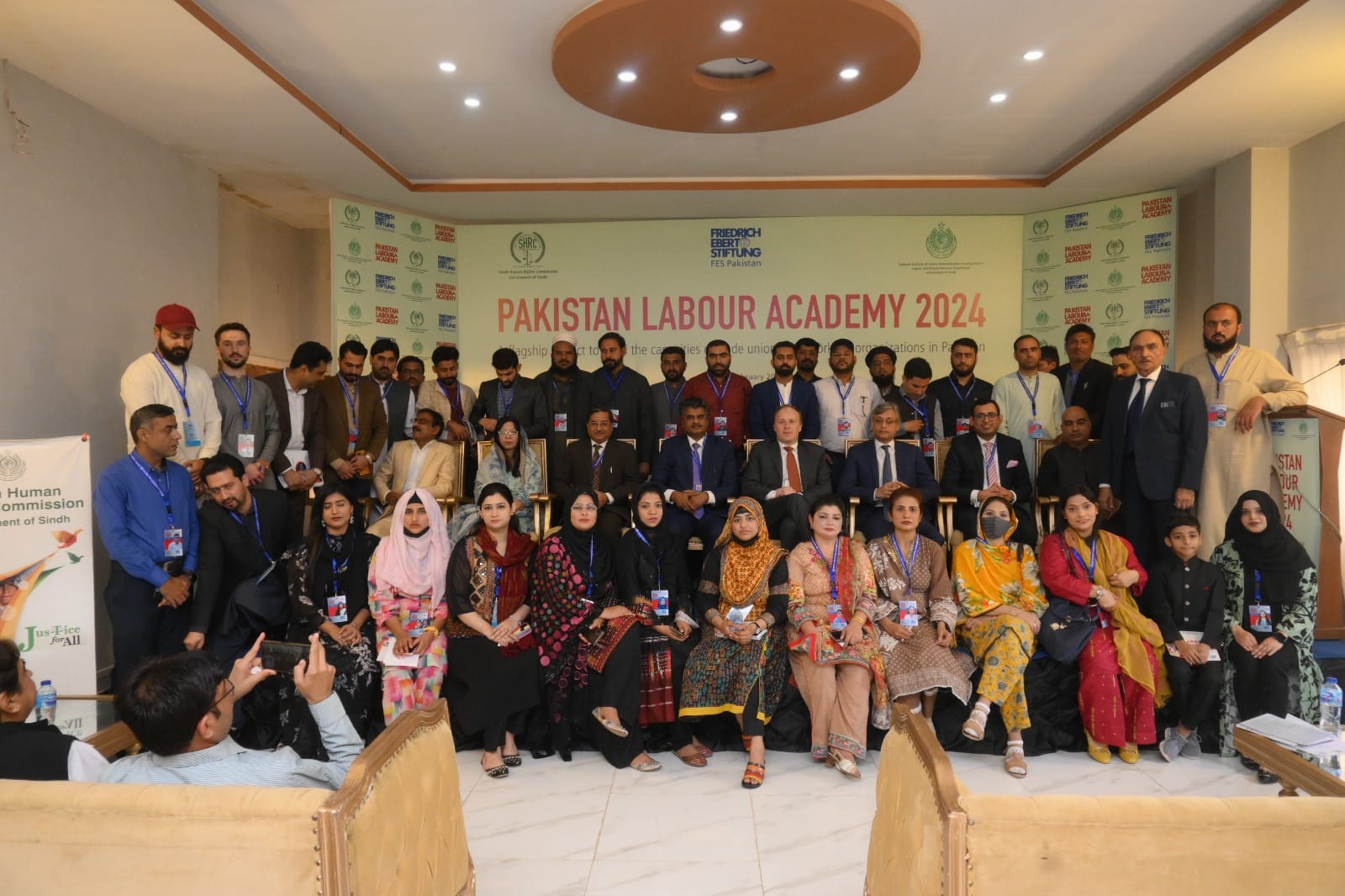
FES Pakistan, alongside SHRC and NILAT,
organized the Inauguration Ceremony for the Second Cohort of the "Pakistan
Labour Academy." The goal is to educate and train young workers from all
four provinces, as well as Gilgit Baltistan and Azad Jammu and Kashmir, on
industrial relations, labor laws, and promoting decent work in Pakistan. The
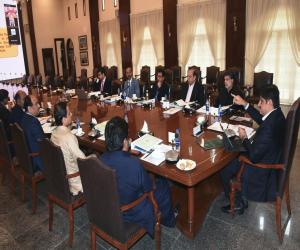
collaborative consultation, led by the Caretaker Minister for Law,
Parliamentary Affairs, and Religious Affairs in Sindh, gathered key departments
and stakeholders for the Inauguration Ceremony.
Dr. Niels Hegewisch, FES Pakistan's Country
Director, commended the collaborative efforts and highlighted FES's global
presence across 100 countries. He emphasized the significance of the current
event as the beginning of expanded networking efforts. Hegewisch reiterated
FES's commitment to laborers in Pakistan, stating that the project reflects
their dedication to future generations of workers. The goal is to empower youth
and integrate them into the global workforce.
Mr. Abdullah Dayo, Program Advisor at
Friedrich-Ebert-Stiftung Pakistan, introduced the Pakistan Labour Academy,
shedding light on FES's foundation and the PLA's inception. He discussed the
comprehensive syllabus, modules, and esteemed faculty of the PLA's second
edition. Dayo emphasized that labor rights are pivotal, cutting across various
rights.
Mr. Iqbal Ahmed Detho, Chairperson of the Sindh Human Rights Commission, emphasized the significance of the Pakistan Labour Academy (PLA) in Sindh, where 17% of the labor force resides. He highlighted the amended Human Rights law's coverage of business practices, enabling the commission to address violations in the private sector. Mr. Detho underscored the commission's role in ensuring labor law compliance, resolving grievances, and bridging policy gaps. He expressed gratitude to FES, NILAT, the Labour and Human Resources Department, the Minister for Law, Religious Affairs, and Human Rights Government of Sindh, and Dr. Niels Hegewisch for their support.

Additionally, Mr. Shariq Ahmed, Secretary of
the Labour and Human Resources Department thanked FES and SHRC for their
efforts in organizing the event. He acknowledged the complexity of the labor
sector, regulated by 27 laws, and praised the PLA as a significant initiative
for enhancing the labor force's well-being.