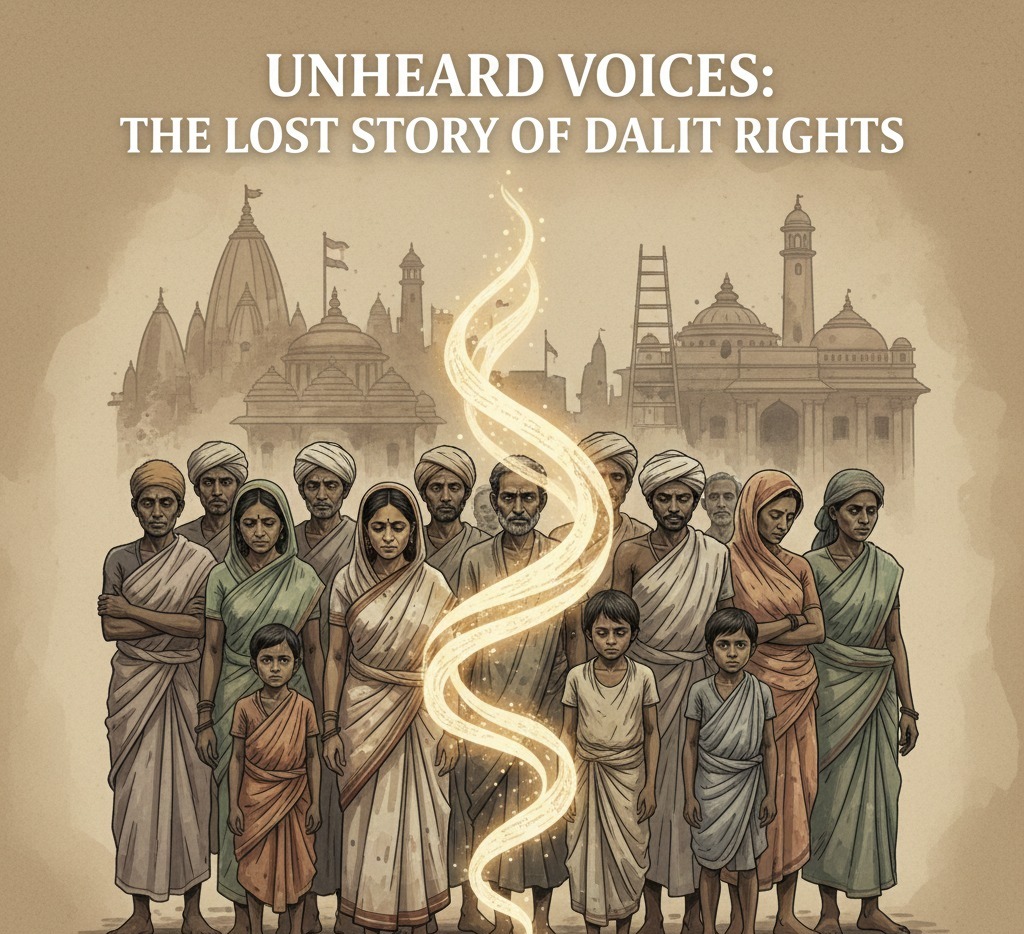
Unheard Voices: The Lost Story of Dalit Rights
 Chehra WebDesk
By Rehana Ali
Dalit and Scheduled Castes
“Dalit” is a socio-political term used in the Indian subcontinent for communities historically placed at the lowest rung of the caste system. The term gained prominence in the 1970s through the ideas of B. R. Ambedkar and Dalit movements.
“Scheduled Caste” is a legal and constitutional category defined in the Constitution of India for communities eligible for reservations and other rights. In practice, Dalits and Scheduled Castes often refer to the same social groups, but “Dalit” represents a broader socio-political identity, while “Scheduled Caste” is a governmental term. For example, the Mahar community is constitutionally recognized as a Scheduled Caste but also identifies socially and politically as Dalit.
The demand for a separate identity arises because some groups want “Dalit” recognized not merely as a bureaucratic category but as a symbol of historical oppression and social awareness.
When Dalits are simply counted as “Hindus,” the specific historical oppression they faced—untouchability, social segregation, restricted access to temples and resources, caste-based violence—gets subsumed under the broader religious identity, obscuring the intensity of their social reality. Similarly, when they are listed only as “Scheduled Castes,” their identity becomes a mere administrative category, minimizing the historical struggle, social dignity, and unique identity of these communities. In both cases, either their issues remain invisible, or their identity is reduced to a bureaucratic label.

Dalit Communities and Scheduled Castes in Pakistan
In Pakistan, 40 non-Muslim communities were declared “Scheduled Castes” under Ordinance XVI of 1957. Most of these were Hindu communities historically socially or economically marginalized. The government recognized them officially, providing special facilities, quota systems, and development programs to ensure equality in society.
Scheduled Castes
The term “Scheduled Caste” refers to communities historically considered socially, economically, and politically disadvantaged. It originated during British rule in the subcontinent and was later legally recognized in both Pakistan and India. Scheduled Castes were previously referred to as “Depressed Classes” or “Untouchables.” These communities faced centuries of social discrimination, economic deprivation, and barriers in education and employment.
Who are considered Scheduled Castes?
Communities historically regarded as socially lower castes, mostly non-Muslim minorities, particularly Hindu Dalits, Bheels, Kolhis, Meghwars, etc., in Pakistan. In India, this category is broader, covering millions of people.
Purpose and Importance
Social Justice: To provide equality for marginalized communities.
Economic Development: Access to education, employment, and business opportunities.
Political Representation: Ensuring their voice in assemblies and institutions.
Scheduled Castes in India
India’s Constitution formally recognizes Scheduled Castes and Scheduled Tribes. Dalits (formerly called Untouchables) fall mostly under this category. They are provided reservations in education, government jobs, and political representation to address historical injustices.

Historical Background
The term “Scheduled Castes” was first used in the Government of India Act of 1935, intended to recognize these communities as “Depressed Classes” and provide them political and social rights. After the Partition of India, the term continued in Pakistan, but over time, their political voice weakened.
Dalit Population Data in Pakistan
Dalits were historically the original inhabitants of the subcontinent, but religious classification pushed them to the lowest social strata. They lacked rights, recognition, and respect.
1951 Census: Hindu population 160,684; Scheduled Caste 369,831 (majority within Hindus but unheard).
1961 Census: Hindu population 203,794; Scheduled Caste also increased; ratio remained but representation absent.
1972 Census: Hindu population 296,837; Scheduled Caste 603,369; clear majority, yet their status remained ambiguous. Early censuses (1951–1972) showed Scheduled Castes comprised 57–67% of Hindus.
1981 Census: The Scheduled Caste category was removed. Hindu population 1,276,118; Scheduled Caste no longer separately counted. The government merged all non-Muslim minorities into one category, citing simplification of census procedures. This erased the separate identity of Scheduled Caste communities, hiding their social and economic issues in official data.
1998 Census: The category returned, but as a diminished figure: Hindu population 2,111,271; Scheduled Caste only 332,343.
2017 Census (PBS National Report): Hindu population 3,595,256; Scheduled Caste 849,614 (23.6%), compared to 57–67% in earlier censuses.

Dalit Identity and Social Challenges
According to Architecture of Caste in Pakistan, caste in Pakistan is not just a remnant of the past nor only a “Hindu issue.” It is a deeply embedded, inter-religious social structure present among Hindus, Muslims, and Christians.
Caste is treated as an analytical category and a core element of identity. The book examines the role of religious, nationalist, and secular elites who maintain privileged structures by denying or reaffirming caste.
Ghulam Hussain notes that in Pakistani society, a person’s first question is often “What is your community?” Identity is equated with caste: those from higher castes announce it proudly, while those from weaker groups hesitate in fear, uncertainty, and insecurity. Such hesitation undermines their ability to claim rights.
He adds that the Dalit movement is no longer as powerful as in 2016–2018, but their demands remain the same: recognition, equality, and justice. The census remains a major issue. With only “Hindu” and “Scheduled Caste” as options, Dalit identity is erased. Most click “Hindu” because acknowledging “Scheduled Caste” is still socially difficult.

Low census numbers reduce rights—quota for jobs, education, budgets, land, and political representation all depend on population counts. Ghulam Hussain emphasizes separate options for “Hindu caste” and “Dalit” in census forms, so Dalits can be counted with their true identity and receive the rights long denied.

Voices of Activists
Mahesh Bheel (PPP, Tharparkar): Dalits face forced religious conversion, forced marriages, and discrimination. He demands legislation in Sindh Assembly to ensure rights to education, employment, and a better life, including a 6% quota under the 1973 Constitution.
Sonu Khangarani: Advocates for a platform for Dalits to assert identity, rights, and history. Believes “Dalit” is not a limited term but a universal concept for all oppressed people—Hindu, Muslim, or Christian.
Mukesh Meghwar: Stresses the ongoing struggle for recognition, equality, and human rights for all marginalized communities.
Progressive Sindhi Literature and Dalit Voices
The progressive era of Sindhi literature provided a voice to Dalits. Storytellers challenged social hierarchies and gave language to Dalit existence.
Jamal Abro’s Shah Jo Pher critiqued Sayyid superiority.
Naseem Kharal’s Kafir depicted broken dreams of equality through Sitl Od’s story.
Inspired by Islamic egalitarianism, some converted religion but caste barriers persisted.
Khurshid Qaimkhani first recognized Dalit identity, and Amar Sindhu connected these voices with education and awareness. This literature represents continuous resistance for those historically marginalized.
Jogindernath Mandal
Jogindernath Mandal belonged to the Shudra caste of Hinduism, known socially as Dalit or “Untouchable.” Born on 29 January 1904 in a peasant family in Bakerganj, Barisal, Bengal, Mandal served as Minister of Law in British Bengal. After the creation of Pakistan, he became the first Minister of Law and Labour under Quaid-e-Azam Muhammad Ali Jinnah.

Following Jinnah’s death, Mandal faced political isolation, distrust towards Hindus, and pressure from the state. In March 1949, he supported the Objectives Resolution, which transformed Pakistan into an Islamic state and denied constitutional recognition to Dalits. He resigned in October 1950, citing violence against Dalits and discrimination by authorities. Mandal later migrated to India and spent the rest of his life in Kolkata, facing criticism there as well.

Radha Bheel
Radha Bheel, 45, daughter of a farmer from Thar, now speaks for Dalits in Mirpur Khas. She describes Dalit identity as a continuous trial of weakness, helplessness, deprivation, and hatred. She demands:
6% quota in employment
Special budget for women
Land rights
Free education from primary to university
Vocational training for girls
Registration of farmers
Legal recognition of Dalit caste in the census