“Awami Tehreek Workshop Concludes in Hyderabad: Vasand Thari Warns of ‘Narcotics War’ Against Sindh”
 Chehra WebDesk
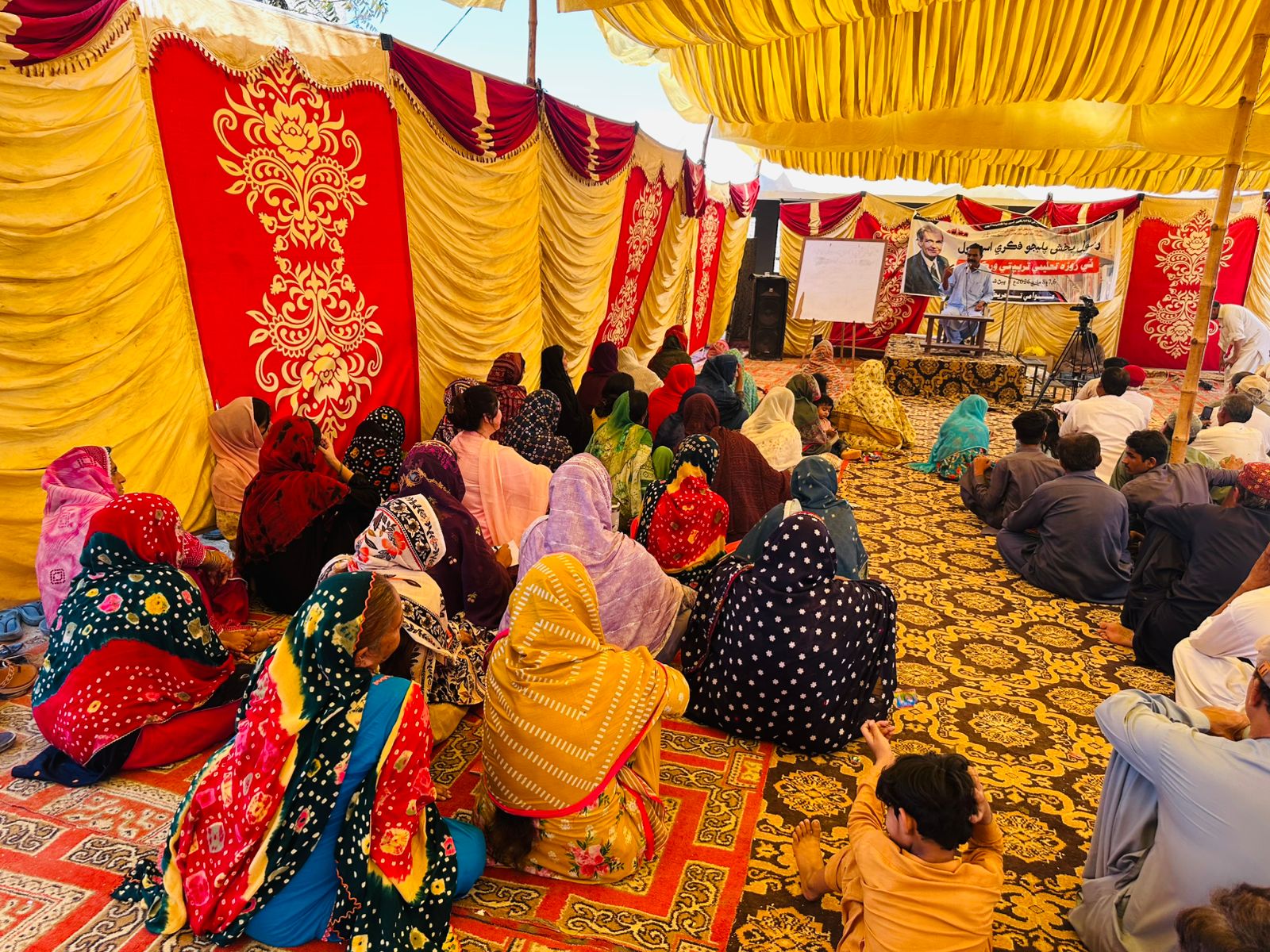
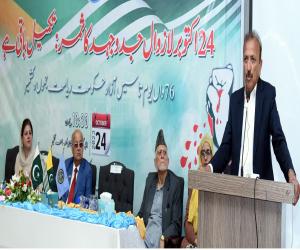
Hyderabad A three-day educational and training workshop of Awami Tehreek, titled “Rasool Bux Palijo School of Thought”, concluded today with the participation of a large number of activists from across Sindh.
Just as the Opium War was imposed on China, a war of narcotics has also been imposed on the Sindhi nation. This was stated by the Central President of Awami Tehreek, Advocate Vasand Thari, while delivering a lecture on the Chinese Revolution.
Hyderabad The three-day educational and training workshop organized by Awami Tehreek under the title “Rasool Bux Palijo School of Thought” concluded on Sunday. The workshop had begun on Friday. A large number of activists from all parts of Sindh participated.
On the third day, Advocate Vasand Thari (Central President Awami Tahreek), central leader Advocate Ismail Khaskheli, Gulan Bhand (General Secretary of Dadu Press Club) and Ali Raza Jalbani delivered lectures respectively on the Chinese Revolution, the current global situation, the poetry of Ustad Bukhari, and the Physics of the Future.

Speaking on the Chinese Revolution, Advocate Vasand Thari said that the secret of China’s current development lies in the Chinese Revolution led by Mao Zedong, the strong discipline of the Communist Party of China, collective leadership, and the adaptation of Marxism according to Chinese conditions. He said the Chinese Revolution is a guiding example for the Sindhi nation, and due to this revolution China has lifted millions of its people out of poverty.
He further said that just as the Opium War was imposed on China to enslave the Chinese nation, similarly a war of narcotics has been imposed on Sindh. Drugs such as ice, charas, opium, cannabis, gutka, mawa, 2100, and Aadab are being sold openly in streets like ordinary commodities. He alleged that narcotics are even transported to shops and cabins through police vehicles. He said that while tomatoes, potatoes, and onions cannot be easily exported or imported to and from Afghanistan or India, narcotics are being smuggled across borders with ease, which clearly indicates that a systematic narcotics war is being waged against Sindh.
He added that the youth of Sindh are being pushed towards drugs in order to keep them away from national and class struggle and to facilitate the plunder of Sindh’s resources. He stressed that intellectuals and conscious segments of society must take this issue seriously and struggle to eradicate narcotics.
He further said that Palijo’s ideology (Fikr-e-Palijo) is the path to the liberation of the Sindhi nation. Rasool Bux Palijo presented a scientific and revolutionary theory suited to the specific conditions of Sindh. In his book “Subah Thindo”, Palijo clearly outlined the ideological line which serves as a guiding intellectual path for the Sindhi nation and identifies the friends and enemies of the working class. He said that without implementing an ideology according to concrete conditions, it cannot produce results. He claimed that Awami Tehreek is the only organization implementing Palijo’s ideological line with clarity and purpose.
Speaking on the global situation, Advocate Ismail Khaskheli said that the sudden rise in petrol prices in Pakistan is due to the greed of rulers and capitalists rather than war. He said Pakistan’s rulers exploit the public even during natural or man-made disasters and are using the Iran–Israel conflict as an excuse to impose a petrol bomb on the people, even though the country still has about a month’s worth of petroleum reserves.
He added that Iran is fighting an anti-imperialist war, therefore it deserves open support. According to him, Iran has already achieved psychological victory in the conflict. He said the Iranian nation is a brave nation defending its 6,000-year-old civilization, whereas the United States does not possess such a civilization. Therefore, Iran holds psychological superiority in this conflict. He claimed that life in Tehran is returning to normal while fear prevails in Israel, but Western media does not report Israel’s fear and destruction. He added that Western media has taken sides with the United States and Israel instead of remaining neutral, which is causing people to lose trust in the media.

Speaking on the poetry of Ustad Bukhari, Gulan Bhand said that the poet expressed every aspect of Sindhi national life in his poetry. He loved the land of Sindh, its people, trees, birds, and all living beings. He was a lover of nature and emphasized collective struggle for national progress.
He further said that the prosperity and greenery of Sindh depend on the Indus River, and any attack on the river is an attack on Sindh’s civilization. He said that no external invader ever took away our river, but present rulers are attempting to do so. He added that Awami Tehreek was the first to raise its voice against this injustice, including against corporate farming and new canals. He also said that the Sindhyani Tehreek rally at Regal Chowk played an important role in mobilizing the nation against canal projects.
Speaking on the Physics of the Future, Ali Raza Jalbani said that the world is focusing on low-energy electronic technologies and moving towards electric vehicles instead of petrol-powered cars. He added that scientists are also working on tiny bee-sized robots, which are currently used for espionage and military purposes, but may also be developed for medical applications in the future.
The workshop was attended by Awami Tehreek’s Central Senior Vice President Noor Ahmed Katiar, central leader Abdul Qadir Ranto, President of Sindhyani Tehreek Umra Samoon, General Secretary of Sindhi Hari Tehreek Darya Khan Zaor, Awami Tehreek Central Joint Secretary Mah Noor Mallah, Deputy General Secretary Advocate Raheel Bhutto, Central Media Secretary Kashif Mallah, central leaders Noor Nabi Palijo, Majeed Sagar Parhyar, Advocate Khalid Tanio, Muhammad Ali Talpur, Sindhyani Tehreek leader Subhani Dahri, Sindhi Mazdoor Tehreek General Secretary Muhammad Ali Khaskheli, Sindhi Shagird Tehreek Organizer Aitizaz Gaincho, and Sarmad Saindad Khaskheli, Organizer of Sujag Baar Tehreek, along with other leaders.
During the workshop, Bakhtawar Mallah, Azmat Halepoto, Raheela Dahri, Dua Bhurgri, Sana Bhurgri and Shoab Bhutto, along with others from Sindhyani Tehreek and Sujag Baar Tehreek, presented national songs, poems, and poetry.