Monsoon Brides: Lipstick of Dreams and the Dampness of Reality
 Imran
Imran
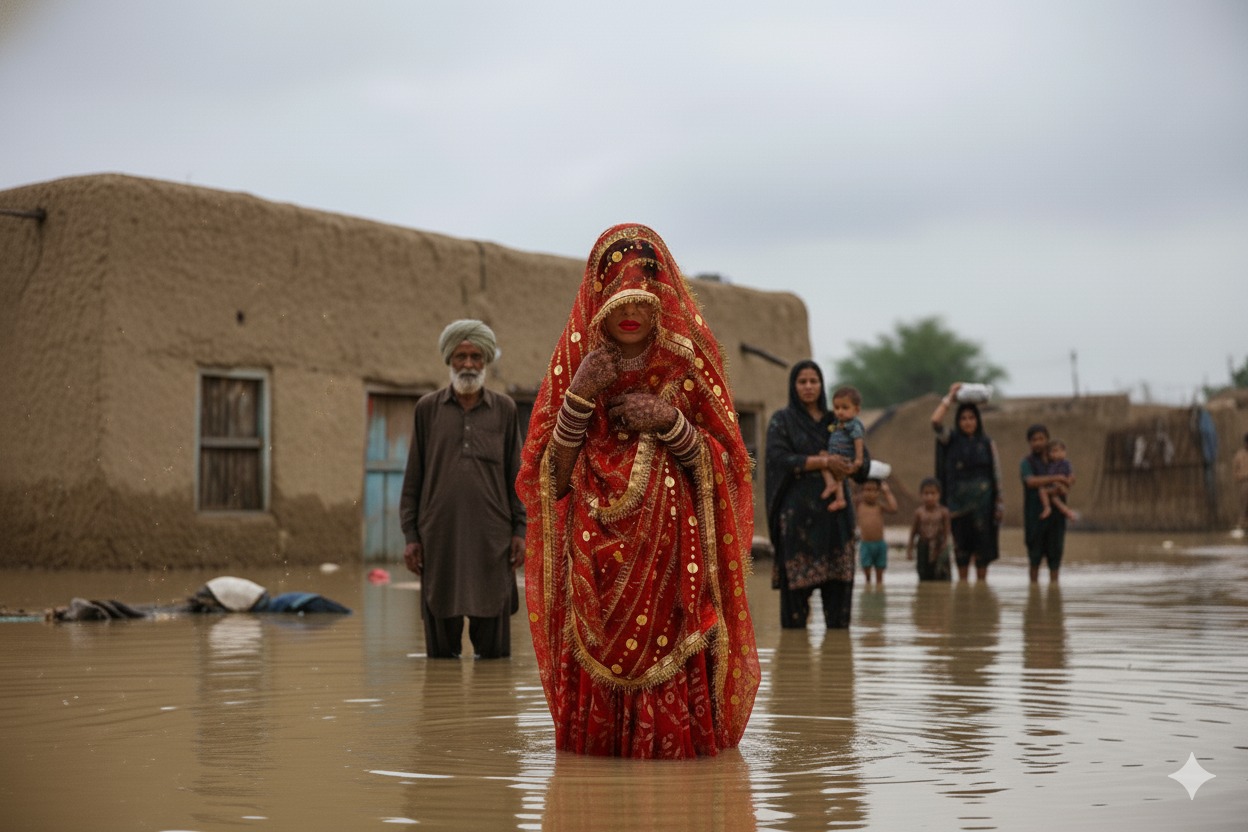
Every monsoon season in Sindh, Pakistan, doesn’t just bring rain—it washes away lives. For thousands of girls like Shumaila, the deluge is not just environmental—it’s deeply personal. When the skies open up, their futures close down. What begins as a climate disaster ends in a child marriage, turning lipstick dreams into survival contracts.
There was a sparkle in Shumaila’s eyes—the kind born from the first stroke of lipstick in every little girl’s imagination. She thought marriage meant colorful clothes, makeup kits, and that lipstick she could never afford beyond the shop’s glass. But when the rains came, her dreams were drenched too.
In Khan Muhammad Mallah village of Dadu, where damp soil clings to poverty, Shumaila and Amna were married off in June’s humidity. They weren’t just brides—they were Monsoon Brides, a haunting term for what happens when floods erase livelihoods and families see marrying off their daughters as the only escape. A childhood is sold for 200,000 rupees.
It has been three years and three monsoons since they were first called Monsoon Brides.
Monsoon Brides: Childhoods Washed Away
“It wasn’t like this before the rains,” says 65-year-old Mai Jannat, eyes heavy with memory. But now, every raindrop is a witness to hunger, and every bride a transaction.
Mashooq, founder of the local NGO Sujag Sansar, explains: “This isn’t just marriage—it’s survival. Parents marry their daughters off to afford a meal, a tent, a tomorrow.”
After the catastrophic 2022–2023 floods, child marriages temporarily surged by 10–15% in affected districts like Dadu, Khairpur, and Tharparkar, according to Shumaila Mazmal of Karachi Spark. But the true scale remains hidden—most cases go undocumented, especially in tribal or remote regions.
Despite laws banning marriage under 18, implementation in rural Sindh remains weak. Cultural pressures, poverty, and the collapse of livelihoods have all fueled the rise in child and early marriage.

The Monsoon That Changed Everything
When monsoon rains began in July 2022, no one expected history to be rewritten in water. Nearly 700 mm of rain fell in Sindh from July to late August—52% above normal, breaking a 30-year record. The last comparable disaster occurred in 1994, with 503 mm recorded.
These rains drowned fields, homes, schools—and childhoods.
In South Asia, the monsoon traditionally brings life to farmlands. But now, climate change has turned this blessing into chaos.
What once sustained is now destroying. What once fertilized is now flooding.
“As floods become more frequent, families in crisis are pushed to desperate decisions—turning daughters into collateral for survival.”
This is no longer just a weather story—it’s a social crisis fueled by environmental collapse.

A Humanitarian Crisis: Mothers, Camps, and Silent Suffering
The 2022 floods didn’t just ruin crops and homes. They fractured systems—especially for women and children.
According to the Sindh Health Department, 19,745 pregnant women were sheltered in flood relief camps. Of these, 4,200 gave birth inside those camps—many without medical professionals, proper hygiene, or even privacy. Every birth was a miracle. Every mother, a warrior.

A December 2022 UNICEF report showed one in nine children in flood-hit areas had been hospitalized due to illness. Malnutrition, unsafe water, and infections ran rampant.
Stunted growth was widespread. This isn’t just a health crisis—it’s a humanitarian emergency.
The floods affected 33 million people, including 16 million children. These numbers aren’t just statistics—they’re stories of dreams lost in water, yet voices that refuse to drown.

Global Aid and the Race Against the Next Disaster
The UK has announced an additional £1.2 million (approx. PKR 45.4 crore) to support anticipatory flood response in Sindh — early warning systems, identifying vulnerable households, stockpiling supplies, livestock protection, and preparing evacuation centres. This brings the UK’s total humanitarian assistance to Pakistan this year to £2.53 million (≈ PKR 95.8 crore), benefitting over 400,000 people.
British High Commissioner Jane Marriott said:
“For every dollar spent on prevention, up to seven dollars are saved in response. More importantly, lives are saved, and destruction is avoided.”
The Cost of Water: Agriculture, Heat, and Climate Migration
The Food and Agriculture Organization (FAO) reported $3.7 billion in damages to agriculture from the floods—60% of all losses.
More than 440,000 acres of crops were destroyed and 800,000 livestock perished.
Long-term studies, such as those in Nature Climate Change, show how heat stress is pushing rural families toward permanent migration.
According to the Global Climate Risk Index 2025 (Germanwatch), Pakistan was the most affected country in the world in 2022.
The climate crisis is no longer distant—it is here, immediate, and personal.
In rural Sindh, the heat doesn’t just dry rivers—it fuels violence and social strain.
Women suffer most. During heatwaves and in relief camps, they endure lack of water, privacy, and safety.
A Shadow of Violence: Gender and Social Breakdown
In March 2025, the Hari Welfare Association released a chilling report.

Top affected districts: Sanghar (160), Khairpur (147), Dadu (116). Even urban Karachi recorded 107 cases.
Low numbers in districts like Kashmore (30) or Thatta (33) may reflect not safety—but silence, fear, and underreporting.
These are not just incidents—they’re echoes of a broken system, of lives lived in the margins and erased in statistics.
Resilience and the Return of Hope
The floods didn’t just damage infrastructure—they shattered dignity.
Girls like Sakina Mallah endured months in tents, denied water, denied toilets, denied the right to speak of menstruation or education.
But the story does not end in despair.
Today, as Sindh’s teachers travel to China for advanced training, and women educators like Roma Abdullah receive national honors, a new narrative is rising—one where women and girls are not victims but leaders, learners, and survivors.
The Final Word: A Global Wake-Up Call
This is not just Pakistan’s story.
It is the world’s climate crisis, written on the bodies of its most vulnerable.
If we do not act—on climate, on child protection, on gender equity—we will be complicit in every Monsoon Bride, every flooded school, every silent birth in a darkened tent.
These stories are not distant tragedies—they are part of our shared future.
Because when the waters rise again, the question won’t be who drowned—but who let it happen